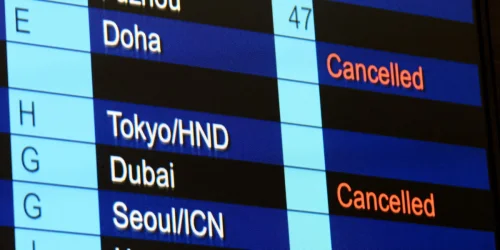
Major airline stocks across Europe and Asia have plummeted following military strikes in the Middle East that forced the closure of airspace across the region, causing massive travel disruption. The initial US and Israeli attacks on Iran, and subsequent Iranian retaliation, led to the shutdown of virtually all airspace over several key nations over the weekend.
Investors reacted swiftly to the potential for long-term disruption to the global airline industry. Tens of thousands of flights were delayed or cancelled, stranding scores of passengers worldwide, largely due to the closure of major hub airports in the Middle East.
European and Asian Markets React
In the first hours of trading in Europe on Monday, shares in the continent's biggest airline groups plunged. Shares in London-listed IAG, the parent company of British Airways, Iberia, and Aer Lingus, were down more than 5%. Paris-listed Air France-KLM shares dropped 8%, and Frankfurt-listed Lufthansa shares were 6% lower.
Earlier on Monday, airlines in the Asia-Pacific region also saw sharp declines. Qantas, Cathay Pacific, Singapore Airlines, and Japan Airlines all saw share price drops in the region of 5% to start the week.
Core of the Disruption
The tumbling stocks reflect the operational chaos triggered by the widespread airspace closures. The nations of Iran, Iraq, Kuwait, Bahrain, Qatar, Israel, and the United Arab Emirates all closed their airspace to civilian traffic.
This had a disproportionate impact due to the role of Middle Eastern hubs in global connectivity. The three major Middle Eastern carriers—Qatar Airways, Etihad Airways, and Emirates—operate hubs that connect passengers to destinations worldwide. When their operations are disrupted, it creates a significant ripple effect across international air travel networks.
Ownership Shields Some Carriers
It is notable that the three largest Middle East-based airlines—Emirates, Etihad, and Qatar Airways—are owned by their respective governments and are not publicly listed. Their financial performance is therefore not immediately reflected in public stock market movements, unlike their European and Asian competitors.
Ongoing Impact and Outlook
While some flights in the region may restart in the coming days, analysts expect disruption to international air travel to continue for many days, if not longer. The closure of such critical air corridors and hub airports represents one of the most significant simultaneous disruptions to global aviation in recent years.