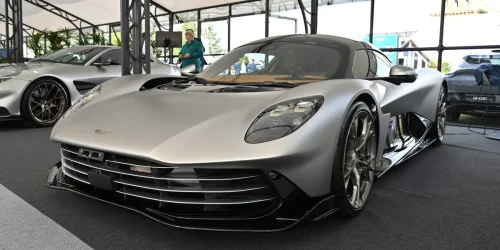
British luxury automaker Aston Martin Lagonda Global Holdings plc is to cut up to 20% of its workforce, the company announced in its full-year 2025 earnings report on Wednesday. The job cuts are part of a restructuring plan expected to deliver annual savings of approximately £40 million ($54 million) in operating expenditure and capital investment.
The iconic manufacturer, famed for producing the sports cars driven by fictional secret agent James Bond, reported a pre-tax loss of £493 million ($666 million) for the year. This significant loss was attributed to a sharp decline in revenue and vehicle sales, which the company's leadership linked directly to heightened trade tariffs and a collapse in demand within the crucial Chinese market.
Trade Turbulence and Financial Strain
In its official statement, Aston Martin cited "heightened tariffs in the US and China" as a primary factor impacting its financial performance. The global automotive industry, which relies on intricate international supply chains, has faced severe disruption from volatile trade policies.
Former US President Donald Trump's administration imposed a 25% tariff on car imports in April 2024, increasing costs for vehicles like the Aston Martin Vantage, which are hand-built at the company's Gaydon factory in Warwickshire, England. While a subsequent US-UK agreement in May 2024 offered some relief, fresh uncertainty emerged after Trump introduced a 10% global tariff on exports to the US, later threatening to raise it to 15%.
"The auto sector has been navigating a perfect storm of trade policy shifts," said an industry analyst. "For premium brands with significant export volumes, like Aston Martin, the additional costs and planning instability are particularly damaging." Major manufacturers including Toyota, General Motors, and Ford have previously stated that adapting to changing trade rules has cost them billions of dollars.
Chinese Market Collapse Compounds Crisis
Alongside tariff pressures, Aston Martin is grappling with a severe downturn in China, once a booming market for Western luxury vehicles. Sales in the Asia-Pacific region plummeted by 21% in 2025, the largest decline of any market for the company.
This reflects an industry-wide trend, where prestige brands like Porsche and Mercedes-Benz have also seen sales plunge. Chinese consumers are increasingly turning to vehicles produced by domestic manufacturers, many of which specialise in electric vehicles (EVs). Aston Martin's current model range is predominantly powered by internal combustion engines.
Chief Executive Officer Adrian Hallmark stated in the earnings release that the restructuring, including the workforce reduction, is "a necessary step to secure the long-term future of the business" amid these "unprecedented external challenges". The company did not provide a specific breakdown of costs directly attributable to tariffs.
Strategic Restructuring and Future Outlook
The planned job cuts, targeting up to 20% of Aston Martin's global employees, form the centrepiece of the firm's new cost-saving initiative. The £40 million in expected savings will be directed towards sustaining operations and funding future product development.
Industry observers note that the company's future strategy will likely need to accelerate its electrification plans to regain competitiveness, especially in key international markets shifting towards EV adoption. The board has indicated that further details on the company's strategic roadmap will be provided to shareholders in the coming months.