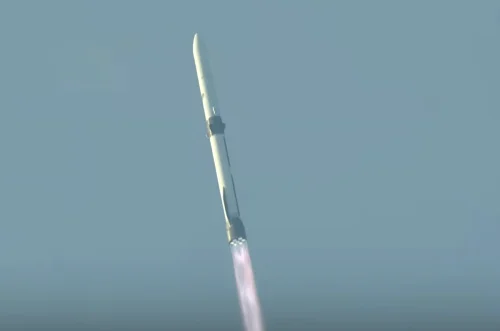
Imagine a world where blasting a rocket into space is as routine as catching a flight. That future just got a massive boost, and it’s coming from a surprising corner of the space race. Blue Origin, the company founded by Amazon billionaire Jeff Bezos, has just achieved something it has been chasing for over a decade—and it could be the key to unlocking the cosmos for good.
On Sunday, for the very first time, Blue Origin successfully re-flew one of its massive New Glenn rockets. This isn't just a technical box-ticking exercise. It’s the **crucial economic breakthrough** that could allow Bezos to finally go head-to-head with Elon Musk’s SpaceX on a level playing field. The question is no longer *if* they can compete, but *how fast*.
The One Trick That Made SpaceX King
To understand why this single launch is so seismic, you have to look at the competition. SpaceX’s dominance isn't just about flashy Starships; it was built on the mundane magic of reusing its Falcon 9 boosters. Landing and re-flying rockets slashes costs astronomically, turning a niche government service into a global launch monopoly. For years, Blue Origin watched from the sidelines. Now, with New Glenn’s third-ever flight, they’ve proven they can play the same game.
"Making New Glenn reusable is crucial to the economics of New Glenn," the report states bluntly. The booster that soared on Sunday was the same one that launched a NASA mission to Mars just last November. After delivering its payload, it touched down on a drone ship in the ocean. This weekend, it did it all over again. **Ten minutes after liftoff, it was back on the boat**, ready for its next journey.
More Than Just a Test Flight: The Real Mission
But this was far from a simple practice run. While the rocket’s first stage was making history, its upper stage was busy on a high-stakes commercial job. Its primary mission was to carry a communications satellite into orbit for AST SpaceMobile, a clear signal that Blue Origin is open for business and ready to carry paying customers.
This move is strategic. Blue Origin isn't just aiming for satellite launches. The company has its sights set on NASA’s moon missions and, critically, helping both itself and its sister company Amazon build vast, space-based internet networks. The clock is ticking, with Blue Origin racing to get its first robotic moon lander ready for a launch attempt later this year.
What This Means for Your Future
So why should you care about a rocket landing on a boat? Because this single act of recycling machinery hurtling through the atmosphere brings the final frontier drastically closer. Cheaper, more frequent launches mean faster satellite internet, more ambitious lunar bases, and a new era of space-based research that could unlock technologies we haven't even dreamed of yet.
The space race is no longer a two-horse contest between billionaires' egos. It’s a fully-fledged, economically-driven sprint to industrialise orbit. With this successful re-flight, Blue Origin has just fired the starting pistol on its most serious lap yet. The landscape of space—and everything it enables on Earth—is about to change forever.