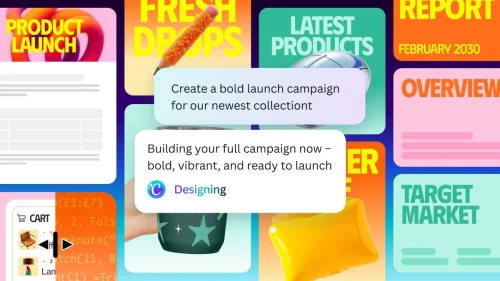
Canva has unveiled a significant upgrade to its AI assistant, enabling it to autonomously call various design tools and schedule repetitive tasks based on user prompts. The 'Canva AI 2.0' update, launched in research preview this week, represents a move towards more agentic, automated workflows for content creation, as the company eyes a potential public listing next year.
The core enhancement allows users to describe a design task, after which the AI assistant plans the process, selects the necessary tools, and generates multiple editable options. Crucially, designs are built using layers, preserving user flexibility for final adjustments. This development aligns with a broader industry trend, following similar AI assistant launches from competitors like Adobe and Figma in recent weeks.
Enterprise Growth and Competitive Context
Canva's co-founder and Chief Operating Officer, Cliff Obrecht, emphasised the platform's role as an end-point for business workflows. "I think a lot of small businesses start and end their day, and they’ll do a lot of their workflows completely, in Canva," Obrecht stated. He noted the platform's strong integration with major AI providers like Anthropic, Google, and OpenAI, allowing external AI agents to call Canva for content, but stressed that the "final mile of editing, collaboration and deployment" remains Canva's strength.
Obrecht revealed that while a significant portion of revenue comes from individuals and small teams, the company's enterprise business is growing at 100% year-on-year. Canva, most recently valued at $42 billion according to PitchBook data, will "likely go public next year," Obrecht confirmed.
Expanded Integrations and New Capabilities
The update significantly expands the AI's context-gathering abilities through new integrations. Users can now opt to allow the assistant to read data from Slack, Gmail, Google Drive, Calendar, and Zoom to inform its task execution. A new web research skill enables the AI to browse the internet to complete user requests.
A key new feature is task scheduling, which lets users instruct the AI bot to set up repeatable background tasks. For safety and control, this function only creates a draft for user review before any posting occurs. The company has also refined existing tools: the AI code generator can now import HTML, and text prompts can be used to describe desired spreadsheets for generation.
Performance Improvements and Availability
Canva claims substantial efficiency gains in its underlying AI models. The company states its Lucid Origin image-generation model is now five times faster and 30 times cheaper to run. Its 12V image-to-video model is reportedly seven times faster and 17 times cheaper.
The Canva AI 2.0 update is launching in a research preview this week, with a full rollout to all users planned for the coming weeks. The development underscores the intensifying race among design and productivity platforms to offer predictive, automated AI workflows that reduce manual steps for professionals and businesses.