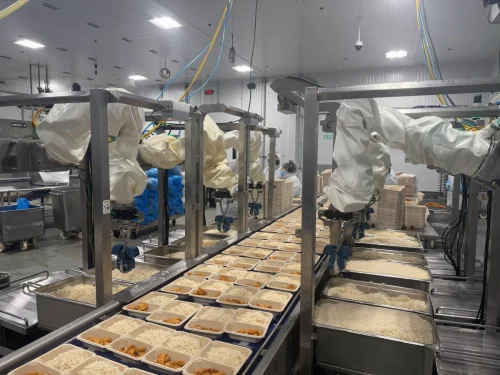
Chef Robotics, a San Francisco-based automation startup, has announced it has surpassed 100 million servings prepared by its AI-powered robotic arms. The company, which originally targeted fast-casual restaurants, has pivoted to serve large-scale food manufacturers and institutional providers, including Amy’s Kitchen and Chef Bombay, as well as one of the largest school lunch providers in the United States.
CEO Rajat Bhageria stated that the food automation sector has historically been a "startup graveyard," citing high-profile failures like Chowbotics and Zume. Chef Robotics’s strategy to avoid this fate involved targeting the food manufacturing sector, where it automates the labour of depositing food portions into meal trays. A company spokesperson defined a "serving" as one component of a full meal placed into a tray.
Strategic Shift to Enterprise and Institutional Clients
The decision to move away from consumer-facing restaurants was an early pivot for the company. “We found success instead in food manufacturing,” Bhageria explained. This shift to enterprise and institutional-scale customers has allowed Chef Robotics to achieve significant operational volume, contributing directly to the 100 million servings milestone.
Bhageria emphasised that the inherent variability of food—its slippery and malleable nature—makes it a uniquely difficult product for robots to handle. The data generated from these 100 million servings is now being fed back into the company’s AI models for food handling and packaging, with the goal of continuously improving the robots' precision and capability.
Expansion Plans Target 'Smaller Kitchens' and New Venues
The company’s next phase of growth involves expanding into what it terms "smaller kitchens." This classification includes surprising candidates, such as "one of the largest airline catering companies in the world," which Bhageria cited as a recently signed customer.
Other expansion targets include ghost kitchens—delivery-only operations that supply meals for services like DoorDash. Looking further ahead, Bhageria added that the company aims to re-enter the fast-casual restaurant market and expand into other high-volume venues like stadiums and prisons.
Data-Driven Improvement and Industry Context
The milestone underscores a rare success story in a challenging niche of robotics. The company’s approach leverages massive operational data to refine its AI, creating a feedback loop intended to enhance efficiency and reliability. This data-centric development model is seen as crucial for scaling the technology in an industry littered with failed attempts to automate food preparation and service.
With the 100 million servings benchmark passed, Chef Robotics is positioning itself for further scaling. The focus remains on leveraging its AI and robotics technology to automate labour-intensive tasks within large-scale food production environments, using the accrued data as a key competitive advantage.