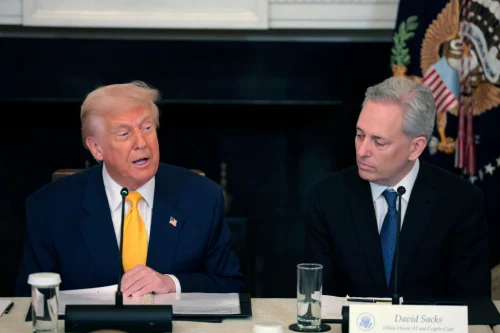
David Sacks, the entrepreneur and investor who served as a special government employee advising Donald Trump on artificial intelligence and cryptocurrency, has confirmed his 130-day tenure in that role has ended. He will now co-chair the President’s Council of Advisors on Science and Technology (PCAST), sharing the role with senior White House technology adviser Michael Kratsios.
In an interview with Bloomberg on Thursday, Sacks stated the move allows him to broaden his focus. “I think moving forward as co-chair of PCAST, I can now make recommendations on not just AI but an expanded range of technology topics,” he said. The shift represents a step back from the direct policy-shaping influence he held as the administration's AI czar.
A Council of Tech Titans
The newly formed PCAST boasts a membership drawn almost exclusively from the executive ranks of the world's most influential technology companies. The initial 15 members include Nvidia CEO Jensen Huang, Meta CEO Mark Zuckerberg, Oracle Chairman Larry Ellison, Google co-founder Sergey Brin, venture capitalist Marc Andreessen, AMD CEO Lisa Su, and Dell Technologies founder Michael Dell.
Sacks described the group to Bloomberg as having “the most star power of any group like this” ever assembled. The council's stated near-term priorities will be advancing the national AI framework released last week and addressing issues in advanced semiconductors, quantum computing, and nuclear power.
From Policy Maker to Advisor
The transition marks a significant change in Sacks's proximity to power. As AI czar, he had a direct line to President Trump and helped shape administration policy. PCAST, however, is a federal advisory body; it studies issues and produces recommendations but does not create policy itself.
Sacks framed the national AI framework as a necessary corrective to a “patchwork of regulation” across U.S. states. “You’ve got 50 different states regulating this in 50 different ways,” he told Bloomberg, “and it’s creating a patchwork of regulation that’s difficult for our innovators to comply with.”
Podcast Comments and a Changed Role
The timing of the role change follows public comments from Sacks that appeared at odds with administration policy. Earlier this month, on the “All-In” podcast he co-hosts, Sacks urged the administration to find an exit from the U.S.-backed war with Iran, outlining escalating risks.
When asked by Bloomberg if those comments were related to his changed position, Sacks distanced himself from foreign policy, stating, “I’m not on the foreign policy team or the national security team,” and clarified his podcast remarks reflected a personal view.
A History of Variable Influence
The influence of PCAST has varied dramatically between administrations. President Obama’s council was notably productive, issuing 36 reports over eight years. President Trump’s first-term council, by contrast, was slow to form and made little policy impact, while President Biden’s version was heavily academic.
The current council’s composition—stacked with corporate leaders from the sectors it will advise on—makes it a unique entity in the body's history dating back to President Franklin D. Roosevelt.
Ethics and Business Interests
The move likely frees Sacks to resume his primary career as an investor and partner at Craft Ventures. Last year, TechCrunch reported that Sacks obtained ethics waivers to maintain financial stakes in AI and crypto companies while shaping federal policy in those areas, a arrangement that drew criticism from ethics experts and lawmakers. A spokeswoman for Craft Ventures has not yet responded to questions regarding his current status.