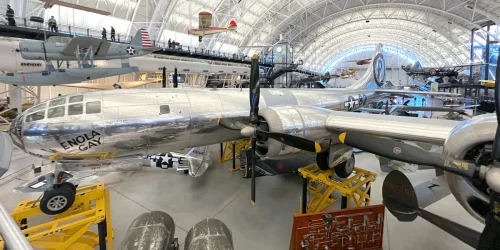
The Enola Gay, the Boeing B-29 Superfortress that dropped the 'Little Boy' atomic bomb on Hiroshima on 6 August 1945, is displayed at the Steven F. Udvar-Hazy Center in Chantilly, Virginia. The aircraft, which measures 141 feet in wingspan and weighs 137,500 pounds, is too large for the Smithsonian National Air and Space Museum's main building on the National Mall in Washington, DC.
The bombing, ordered by US President Harry S. Truman, aimed to force a swift end to the Second World War. The mission was commanded by Colonel Paul Tibbets, who piloted the aircraft named after his mother.
Restoration and Display
It took museum staff 300,000 hours to reassemble and restore the Enola Gay, with its parts transported in 12 truckloads. The Udvar-Hazy Center, with 340,000 square feet of exhibit space, houses over 200 aircraft, with the Enola Gay as a centrepiece among other World War II planes like the Northrop P-61C Black Widow.
In 1995, parts of the bomber were displayed in Washington, DC, for the 50th anniversary of the Hiroshima bombing. The accompanying exhibition's script was rewritten several times amid intense debate between veterans' groups and anti-war activists over how to frame the decision to use the atomic weapon.
The Hiroshima Mission
To carry the 9,700-pound uranium bomb, the B-29 was stripped of all protective and defensive armament except its tail guns and left unpainted, saving 850 pounds. The 509th Composite Group, hand-picked and trained at Wendover Airfield in Utah, carried out the mission.
The initial blast killed at least 70,000 people, with later estimates from Japanese scientists in the 1970s suggesting 140,000 deaths. The US Department of Energy notes the five-year death toll may have exceeded 200,000 due to radiation effects.
Legacy of a Nuclear Age
A second atomic bomb, 'Fat Man', was dropped on Nagasaki on 9 August 1945 by the B-29 Bockscar, now displayed at the National Museum of the US Air Force in Dayton, Ohio. Japan announced its surrender on 15 August.
Over 80 years later, the Enola Gay's permanent exhibition takes a minimalist approach, presenting the aircraft without extensive commentary, leaving visitors to contemplate its role in ushering in the nuclear age.