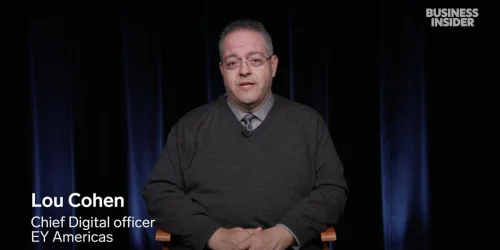
Lou Cohen, Chief Digital Officer at professional services giant EY and a professor at multiple New York universities, has issued a stark warning to the marketing industry. He argues that professionals must learn to make artificial intelligence work for them strategically, or they will end up "working for it." Cohen made the remarks during an interview for CMO Insider at Business Insider's studio in New York City.
Cohen described the current moment as an "inflection point" for marketing. He stated that the significant investments made over the past 15 years in general digital transformation are now pivoting towards a new phase of AI transformation. The potential outcomes, he explained, include deeper audience segmentation, more efficient advertising, and faster content testing to reach the right audiences.
The Assistive Approach Versus Hallucination Fears
Despite the potential, Cohen acknowledged widespread apprehension. "Marketers are not totally comfortable with this because we're so worried that it's going to hallucinate or give us something that isn't accurate," he said. He emphasised the critical difference between probabilistic outcomes from large language models (LLMs) like ChatGPT and deterministic results from traditional search engines.
"When you're doing a search on Google or Bing, for example, you are getting a deterministic response... Versus with the LLMs... you're getting a probabilistic response," Cohen clarified. This distinction means LLMs are best used not as definitive truth-tellers but as advanced assistants for generating ideas and providing feedback.
Learning from Failure and Enhancing Human Creativity
Cohen expressed confidence that the marketing function would ultimately embrace AI, citing the profession's experimental nature. "Marketers, they're not afraid to try things," he said. "We're going to learn more from the things that we fail with and that don't work than the things that do."
He provided a concrete example from EY, where AI is used to evaluate and provide recommendations on improving partner-written content. However, he drew a clear line: "We're not likely to use content created by AI. But we certainly can use AI to enhance and give feedback to our content creators."
Cohen's vision positions AI as a powerful marketing assistant for real-time ideas and suggestions, augmenting human capability rather than replacing the creative task itself. The successful marketer, he implies, will be the one who masters this collaborative, assistive relationship with the new technology.