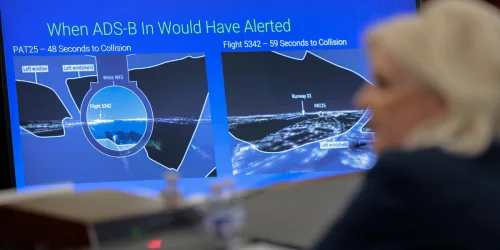
A bipartisan bill to mandate cockpit displays showing nearby air traffic has failed in the US House of Representatives by a single vote, leaving aviation safety advocates and crash victims' families deeply disappointed. The proposed ROTOR Act, which had passed the Senate and was backed by unions, airlines, and the National Transportation Safety Board (NTSB), was defeated on a procedural measure requiring a two-thirds majority.
The legislation sought to address a critical safety gap highlighted by the fatal collision between an American Airlines jet and an Army helicopter near Washington D.C.'s Ronald Reagan National Airport in January 2025, which killed 67 people. At the heart of the bill was a requirement for commercial aircraft to be equipped with "ADS-B In" technology, allowing pilots to see other aircraft on their cockpit screens.
Technology at the Heart of the Dispute
The proposed ADS-B In system acts as a listening device, displaying nearby air traffic to pilots. Its sister technology, "ADS-B Out," which broadcasts an aircraft's position, has been mandatory since 2020. Aviation safety expert Professor Kivanc Avrenli of Syracuse University stated that had the American Airlines jet been equipped with ADS-B In, its pilots would have had 59 more seconds to react before the impact, instead of the 19-second warning they received.
"In dense airspace, that extra 40 seconds can be the difference between having time to sort out a conflict and having no real options left," Avrenli told Business Insider. "Delaying these upgrades means continuing to rely on systems that simply were not built for this kind of scenario."
Republican Opposition and an Alternative Bill
The bill split House Republicans, with 132 members voting against it. Opponents, including Representatives Mike Rogers and Sam Graves, argued the technology would be expensive, unproven, and logistically burdensome for the roughly 5,500 aircraft that would need retrofitting. They have instead championed an alternative bill, the ALERT Act.
The ALERT Act would not mandate ADS-B In, maintaining the current system where air traffic controllers are primarily responsible for collision alerts. It would also allow certain military flights to opt out of transmitting their positions, citing national security risks. Graves argued this bill represents a "comprehensive package" addressing all 50 NTSB safety recommendations, unlike the ROTOR Act which he said addressed only two.
Safety Board Condemns "Watered Down" Alternative
NTSB Chair Jennifer Homendy has strongly criticised the ALERT Act, calling it "watered down" and insufficient to prevent future accidents. The NTSB has recommended cockpit ADS-B In displays since 2008. Homendy highlighted that the cost may be lower than critics claim, citing American Airlines' retrofit of Airbus A321s at less than $50,000 per plane and portable receivers for smaller aircraft costing as little as $400.
The Pentagon initially supported the ROTOR Act but reversed its position on Monday, warning of "significant unresolved budgetary burdens and operational security risks." The failure of the bill leaves the Federal Aviation Administration without a clear mandate to require the technology, a step it has never taken due in part to funding concerns.
With the legislative path blocked, the responsibility for implementing the safety technology now falls to individual airlines. Some carriers, including American Airlines and JetBlue, have voluntarily begun adding ADS-B In to their fleets. Safety advocates warn that without a federal mandate, the pace of adoption will be uneven, leaving what they see as a critical vulnerability in the national airspace system unaddressed.