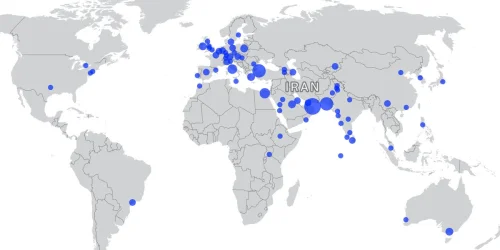
Air travel across the Middle East has been thrown into chaos following military strikes on Iran, forcing the diversion of at least 145 commercial flights. The disruption, tracked by aviation analysts, has seen planes bound for major Gulf hubs rerouted to destinations as far afield as Europe and Pakistan.
The data, compiled from Flightradar24 arrivals lists for five key regional airports, shows the scale of the operational crisis. As of 9:30 a.m. EST, 63 flights were diverted from Doha's Hamad International Airport, 47 from Dubai International, 16 from Abu Dhabi International, 16 from Sharjah International, and three from Bahrain International Airport.
Widespread Operational Chaos
The diversions have scattered aircraft across 73 different airports. Muscat International Airport in Oman received the highest number, with 17 diverted flights. A further 11 flights landed in Istanbul, Turkey, and another 11 in Karachi, Pakistan.
Dozens more flights were forced to return to their points of origin or land in unexpected European cities. An American Airlines flight from Philadelphia to Doha executed a U-turn over Ireland and was set to return to its starting point after a 13-hour flight. An Emirates flight from Seattle diverted to Warsaw, Poland, while another from New York landed in Vienna, Austria.
Costly Impact on Global Carriers
The affected region is home to some of the world's busiest air corridors and major global carriers including Qatar Airways, Emirates, Etihad Airways, and Saudia. Flightradar24 data indicates approximately 3,400 scheduled flights were destined for the area today, with many likely to be cancelled while airspace remains restricted.
"Diversions are costly because airlines have to pay for extra fuel, labor, and any passenger compensation," explained an aviation analyst. "Airline operations centres – which manage cancellations, delays, and crew logistics – are likely overwhelmed."
Knock-on Effects and Private Aviation
The disruption extends beyond commercial aviation. Flightradar24 also tracked the diversion of a private Bombardier Global 7500 jet, which was en route from Geneva to Sharjah but was forced to land in Cairo, Egypt. The cascading effect of these diversions is expected to cause significant schedule disruptions for airlines in the coming days as they work to reposition aircraft and crews.
Aviation authorities have not provided a timeline for the reopening of the affected airspace. The ongoing situation suggests further cancellations and schedule modifications are imminent for flights transiting the Middle East.