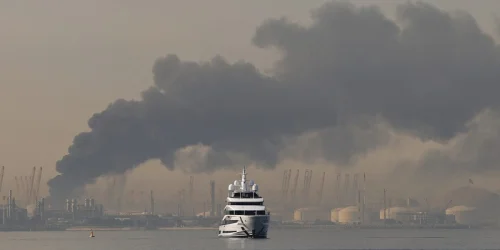
Iran launched retaliatory strikes against more than six countries across the Gulf on Saturday, including the United Arab Emirates, in a significant escalation following US and Israeli attacks. The operation, which Iran stated targeted bases hosting US forces in the region, resulted in intercepted missiles streaking across the sky over Dubai, a major global tourist hub.
Debris from the intercepted projectiles sparked fires and caused other issues, with the luxury Fairmont hotel on the Palm Jumeirah reportedly being hit. The attacks prompted widespread chaos at regional airports, leading to mass flight cancellations as aircraft scrambled to clear airspace over Iran.
Supreme Leader's Compound Damaged
Satellite imagery analysed in the aftermath shows extensive damage to the Tehran residence of Iranian Supreme Leader Ali Khamenei. Khamenei was killed on Saturday, though it remains unclear if he was present at the compound when it was struck. The visual evidence provides a stark indicator of the scale and precision of the initial US and Israeli operation, codenamed "Operation Epic Fury" by the Trump administration.
Regional Aviation in Disarray
The retaliatory strikes caused immediate and severe disruption to air travel across the Middle East. Major airports, including those serving as international transit hubs, enacted emergency procedures, cancelling flights and redirecting aircraft away from the conflict zone. The disruption is expected to have a significant impact on regional connectivity and tourism for the foreseeable future.
The luxury Fairmont hotel on the Palm Jumeirah was among the properties damaged by falling debris from intercepted missiles. The iconic hotel is a landmark on the man-made archipelago and a symbol of Dubai's high-end tourism industry. Emergency services were deployed to the site to contain fires and assess structural integrity.
Context of the Escalation
This exchange marks a dangerous new phase in regional tensions, directly drawing tourist-centric economies like the UAE into a military confrontation. The US and Israeli strikes that precipitated Iran's response were described by Washington as a targeted operation. Iran's decision to retaliate against multiple nations, including non-belligerent states with US military facilities, represents a broadening of the conflict's geographical scope.
Security analysts warn that the targeting of civilian infrastructure, even incidentally, and the death of a head of state could lead to further unpredictable escalation. The international community has called for immediate de-escalation, while regional governments assess the security and economic fallout from the attacks.