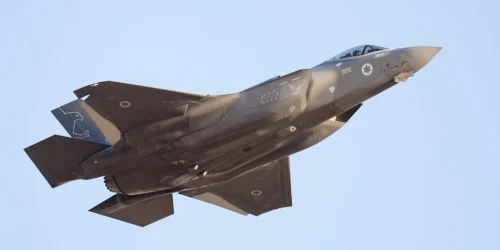
The Israeli Air Force (IAF) conducted what it termed "the most extensive aerial operation ever conducted" on Saturday, deploying its advanced F-35I "Adir" stealth fighter jets in a large-scale assault on Iranian military infrastructure. The strikes, part of an operation codenamed "Roaring Lion" or "Epic Fury," targeted over 500 Iranian missile launchers and aerial defence systems, significantly degrading Tehran's offensive capabilities, according to the Israel Defense Forces (IDF).
IDF spokesperson Lt. Col. Nadav Shoshani characterised the mission as critical to preventing an existential threat. The operation also resulted in the deaths of senior Iranian military leaders, including Defence Minister Aziz Nasirzadeh and IRGC commander Mohammad Pakpour.
The 'Mighty One' on the Front Lines
The F-35I "Adir" – "Mighty One" in Hebrew – was central to the mission. Israel was the first country to acquire the US-made Lockheed Martin F-35 through the Foreign Military Sales process, purchasing 50 units financed by American military aid. The Israeli variant is uniquely customised with domestically manufactured wings, a proprietary electronic warfare system, and a high-tech helmet that projects crucial flight and targeting data onto the pilot's visor.
Lockheed Martin CEO Marillyn A. Hewson stated in 2018 that the aircraft "can fly in what we call 'beast mode,' carrying up to 18,000 pounds of internal and external ordnance." The F-35's design, with internal weapons storage, aligned edges, and radar-absorbent coating, provides advanced stealth capabilities, though it costs approximately $44,000 per hour to operate.
A History of High-Profile Missions
This latest assault is part of a series of high-stakes operations involving the F-35I. The jets were previously used in preemptive strikes against Iran's nuclear programme in June and were pivotal in intercepting hundreds of drones, missiles, and rockets during a major Iranian retaliatory attack in 2024. In 2023, an Israeli F-35I achieved the first known intercept of a cruise missile by an F-35 platform, downing a missile fired from Yemen.
"We are flying the F-35 all over the Middle East and have already attacked twice on two different fronts," former IAF chief Major-General Amikam Norkin told a gathering of foreign air force leaders, as reported by Reuters.
Context: Escalation and Nuclear Fears
The strikes targeted Iran's largest uranium enrichment site in Natanz among over 100 sites, which the IDF said was aimed at preventing Iran from developing a nuclear weapon. The military stated that Iran's nuclear programme had "accelerated significantly" in recent months, calling it "clear evidence that the Iranian regime is operating to obtain a nuclear weapon." Iran maintains its programme is for civilian purposes only.
The operation follows a major attack on Israel in April 2024, where Iran and its proxies launched over 350 ballistic missiles, cruise missiles, and UAVs. Around 99% were intercepted by Israel and its allies, with minor damage reported at the Nevatim Airbase, which houses the F-35I fleet. "Iran thought it would be able to paralyze the base and thus damage our air capabilities, but it failed," IDF spokesperson Rear Adm. Daniel Hagari said at the time.
Broader Regional Conflict and Scrutiny
This escalation occurs against the backdrop of the ongoing conflict sparked by the Hamas attacks on October 7, 2023, which killed around 1,200 Israelis. Israel's subsequent military campaign in Gaza has resulted in over 72,000 Palestinian fatalities, according to the Hamas-run Ministry of Health, displacing 1.9 million people. The devastating human toll, coupled with the use of US-funded aircraft like the F-35I, has prompted new scrutiny in the US Congress over military aid to Israel, with some lawmakers raising the possibility of conditioning such support.