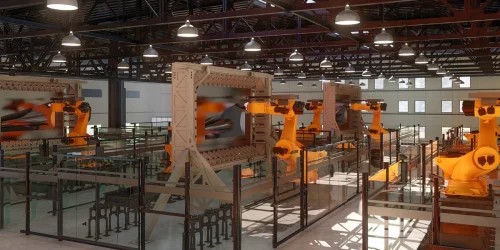
American robotics startup Machina Labs has secured $124 million in a Series C funding round to build a major new factory, betting that flexible, portable robotic systems represent the future of US manufacturing. The investment, led by Lockheed Martin Ventures and Toyota's venture arm, will fund a 200,000-square-foot facility featuring 50 robots, a significant scale-up from its current operation.
The company's core thesis, according to co-founder and CEO Edward Mehr, is that America cannot compete with established manufacturing giants like China by replicating their centralised, traditional factory models. Instead, the nation must "leapfrog" to the next generation of distributed and flexible production.
A Strategic Leapfrog
"It's going to be a miracle to catch up if you want to replicate what they have," Mehr stated in an interview. "It's just not the right chess move. We need to try to see if we can leapfrog and then do the next generation." Machina Labs specialises in producing complex metal structures for the defence, aerospace, and automotive sectors.
The startup claims its value lies in two key areas: flexibility and portability. Its robotic systems can switch between different manufacturing operations without the lengthy retooling required in conventional factories. Furthermore, the portable nature of the technology means factories do not need to be custom-designed for specific products.
The Scale-Up Challenge
The new factory will initially serve defence contractor Lockheed Martin, with a goal of producing "a few thousand structures every year." This marks a substantial increase from its current pilot facility, which operates 10 robots and has an annual output of a few hundred units. The broader industry is still in early stages, with Mehr predicting a major, "ChatGPT-like breakthrough" for robotics in factories is still about five years away.
While the field is crowded with competitors like Tesla and Amazon pursuing automation, Mehr argues that Machina Labs' combination of portability and flexibility is unique. "We're almost rethinking a lot of the manufacturing processes from scratch," he said. "If you go to our factory, things are being built in a way that you cannot see in any other place."
The Human Element
The expansion comes amid high tensions regarding automation's impact on blue-collar jobs. However, Machina Labs' new facility will employ approximately 150 human workers, a figure Mehr says is comparable to a traditional, robot-free factory of similar output. The nature of the work, however, is transformed.
According to an internal company survey, employee interest levels are "exceptionally high." Mehr contrasts the new roles with repetitive traditional assembly work: "You're working with robots. You're working with software... Now, you almost feel like you're playing a game." The company must now prove its model can deliver the promised cost savings and efficiencies at commercial scale.