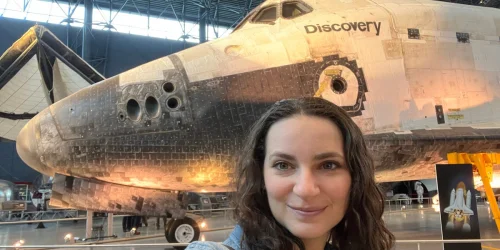
The Steven F. Udvar-Hazy Centre, the second location of the National Air and Space Museum, houses over 200 significant aircraft and spacecraft in a 340,000-square-foot hangar in Chantilly, Virginia. Public affairs specialist Holly Williamson describes the collection as containing "the first, the last, the only, the last remaining, the most significant" artefacts. Unlike the flagship museum in Washington, D.C., the Udvar-Hazy Centre does not require timed-entry tickets, though parking costs $15.
The centre provides a permanent home for some of the most consequential machines in aviation and space history, which cannot be displayed in the smaller D.C. building. Visitors can explore exhibits, watch live restoration work, and use a 164-foot observation tower to view operations at nearby Dulles International Airport while listening to live air traffic control audio.
Historic Bomber and Supersonic Jets
Among the most prominent exhibits is the Boeing B-29 Superfortress Enola Gay, which dropped the first atomic bomb used in warfare on Hiroshima on 6 August 1945. The "Little Boy" bomb weighed 9,700 pounds, forcing the removal of most of the aircraft's defensive armament. The plane's display sparked significant controversy when it was first exhibited in 1995.
The centre also features pioneering commercial jets. The Boeing 367-80 prototype ("Dash 80"), built in 1952, led to the first U.S. jetliner, the Boeing 707. It flew 100 mph faster than the UK's de Havilland Comet and had a range over 3,500 miles. An Air France Concorde is also on display; the supersonic airliner's fastest New York to London flight lasted just 2 hours, 52 minutes, and 59 seconds.
Cold War Reconnaissance and Space Exploration
A Lockheed SR-71A "Blackbird" reconnaissance aircraft, designed to evade missiles during the Cold War, is a key exhibit. Capable of flying over 85,000 feet high at more than three times the speed of sound, this particular Blackbird served for 24 years, logging 2,801.1 flight hours before retiring in 1990. Its black paint helped absorb radar signals.
Dominating the space hall is the Space Shuttle Discovery. The orbiter measures 122 feet long, 78 feet wide, and 57 feet tall, and weighed around 250,000 pounds when fully loaded. Discovery spent 365 total days in space between 1984 and 2012, deploying the Hubble Space Telescope in 1990 and becoming the first shuttle to dock with the International Space Station in 1999.
Live Restoration and Unique Artefacts
Visitors can observe ongoing restoration projects from a public balcony. Current works include "Flak-Bait," a Martin B-26 Marauder that flew 202 combat missions in World War II, and a Sikorsky JRS-1 seaplane present at Pearl Harbor during the 1941 attack.
The collection also includes the Manned Maneuvering Unit (MMU) used by astronaut Bruce McCandless in 1984. Powered by nitrogen jets, the backpack allowed him to make the first untethered spacewalk, flying approximately 300 feet from the Space Shuttle Challenger.
The Udvar-Hazy Centre represents a massive expansion of the National Air and Space Museum's public footprint. With its extensive collection requiring nearly 10,000 steps to explore fully, it serves as an essential destination for aviation and space enthusiasts seeking to engage directly with the physical artefacts of technological history.