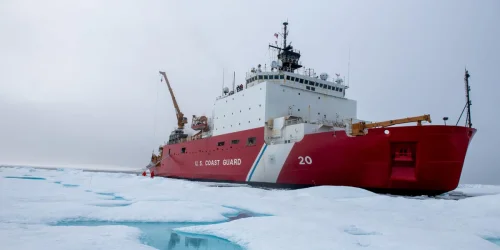
NATO forces are falling behind Russia and China in the race to build icebreakers, ships that would be crucial in any future Arctic conflict, a top Norwegian military official has stated. Vice Admiral Rune Andersen, chief of the Norwegian Joint Headquarters, identified this as a key capability gap for the alliance in the strategically vital region.
The disparity is stark: Russia possesses roughly 40 icebreakers, while China fields around five and is actively expanding its fleet in partnership with Moscow. In contrast, the United States operates just one heavy polar icebreaker, a situation the previous administration labelled a "national security risk."
The Strategic Icebreaker Gap
Icebreakers are purpose-built to crush ice blocking waterways, enabling movement across frozen terrain to access trade routes, natural resources, and potential battlespaces. Vice Admiral Andersen stated the West has been "falling behind" in its ability to operate fully in the Arctic compared to its rivals. This comes as Arctic security becomes a growing focal point for NATO amid expanding Russian and Chinese activity.
While Canada, Finland, and other NATO allies add dozens of icebreakers to the Western arsenal, Arctic experts note nearly a third are past their design life. Furthermore, Russia's fleet is heavier and more specialised for heavy-ice operations than many alliance vessels.
Western Efforts to Close the Divide
Allied nations have acknowledged the deficit and are taking steps to address it. The previous US administration announced plans to order four medium icebreaking Arctic Security Cutters from Finland and build another seven in American shipyards using Finnish expertise. The US Coast Guard assesses it needs at least nine such ships to serve year-round national security needs in the Arctic.
Finland is the world leader in icebreaker production, having designed 80% and built 60% of the global fleet. Commander Arlo Abrahamson, a spokesperson for NATO’s Allied Maritime Command, confirmed member states "are making tangible investments in icebreakers," adding that collective capabilities provide allied navies the ability to operate in Arctic conditions.
Broader Arctic Posture
Beyond icebreakers, NATO allies are investing in other technologies to improve their Arctic foothold, including surveillance capabilities, drones, satellites, and cold-weather vehicles. Western forces have also increased the scale of Arctic exercises to familiarise soldiers with the harsh terrain and launched new deterrence operations across the region.
A NATO official, speaking anonymously, suggested that while Russia may have more maritime platforms, it still faces readiness challenges affecting its ability to project force. This creates "strategic dilemmas with their force projection," the official said.