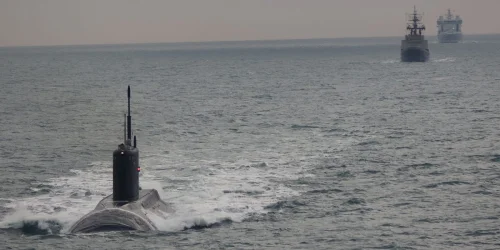
Russia is compensating for its smaller conventional military forces compared to NATO by focusing on advanced submarines and experimental nuclear weapons, according to a top Norwegian military official. Vice Admiral Rune Andersen, Chief of the Norwegian Joint Headquarters, told Business Insider that this "inherent asymmetry" has led Moscow to prioritise unconventional capabilities.
Andersen stated that Russia, with an estimated 1.1 million active-duty troops, cannot match the combined conventional strength of the 32-member NATO alliance. This disparity is exacerbated by heavy losses in Ukraine, where British intelligence estimates Russia has suffered 1.2 million casualties. NATO Secretary General Mark Rutte reported 65,000 Russian soldiers killed in December and January alone.
Submarine Fleet as a Key Asymmetric Advantage
One of Russia's primary asymmetric advantages is its submarine force, one of the world's largest with over 60 boats. Andersen explained that since Russia cannot compete with NATO's integrated surface fleet of advanced warships and aircraft carriers, it is prioritising underwater dominance. "Submarines are inherently asymmetric. Underwater is the last place on earth where you can hide," he said.
Commander Arlo Abrahamson, a spokesperson for NATO's Allied Maritime Command, confirmed that Russia regularly deploys submarines to the Arctic and High North. He noted that 14 NATO member states operate submarines and the alliance is collectively strengthening its anti-submarine warfare capabilities in response.
Investment in Experimental 'Super Weapons'
Alongside its submarine programme, Russia is developing new weapons systems as part of its asymmetric strategy. Andersen identified two experimental munitions: the nuclear-powered 9M730 Burevestnik cruise missile and the autonomous Poseidon nuclear torpedo. Russian officials disclosed successful tests of both weapons in October 2024.
The Burevestnik (NATO designation SSC-X-9 Skyfall) reportedly flew 8,700 miles for 15 hours, while the Poseidon torpedo launched from a submarine and activated its nuclear power unit. These are two of six "super weapons" unveiled by President Vladimir Putin in 2018, designed to have unlimited range and bypass missile defences.
Strategic Shift Towards Nuclear Deterrence
The development of these systems represents a continued investment in Moscow's nuclear capabilities. Andersen suggested that, given Russia's conventional losses in Ukraine, nuclear weapons are becoming "relatively more important to Russia as the core element of any big power ambitions they might have."
The other weapons in Russia's advanced arsenal include the Kinzhal air-launched ballistic missile, the Zircon ship-launched hypersonic cruise missile, the Avangard hypersonic glide vehicle, and the Sarmat intercontinental ballistic missile—all capable of carrying nuclear warheads.
While some of these hypersonic weapons have been used in Ukraine with mixed results, their ongoing development signals a long-term strategic focus. Military analysts conclude that Russia's doctrine is evolving to rely more heavily on nuclear deterrence and asymmetric naval power to counterbalance NATO's superior conventional forces.