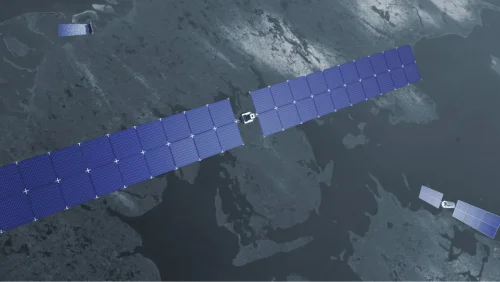
Sophia Space, a California-based startup, has secured $10 million in seed funding to develop and demonstrate a new type of passively-cooled computer designed for orbit. The funding round was led by Alpha Funds, with participation from KDDI Green Partners Fund and Unlock Venture Partners.
The company plans to use the capital to first validate its thermal management technology on the ground, before purchasing a satellite bus from Apex Space to conduct an in-orbit demonstration by late 2027 or early 2028. The core challenge Sophia Space addresses is the difficulty of cooling high-powered processors in the vacuum of space, where traditional air-cooling methods are impossible.
From Solar Power to Space Computing
The startup's technology originates from a $100 million-endowed research program at the California Institute of Technology (Caltech) focused on developing orbital solar power plants. Researchers there devised a thin, flexible, sail-like structure, a design that Sophia Space's founders have repurposed for computing.
Leon Alkalai, the company's Chief Technology Officer and a fellow at Caltech-managed NASA's Jet Propulsion Laboratory (JPL), identified the potential to use this design to power and cool space-based processors. "It’s cold in space…[but] there’s no airflow, and so the only way to to dissipate is through conduction," noted NVidia CEO Jensen Huang recently, highlighting the industry-wide thermal challenge Sophia aims to solve.
The TILE Architecture
Sophia Space, an NVidia partner, has developed modular server racks called TILES. Each TILE is one meter square, a few centimeters deep, and integrates solar panels directly into its structure. This thin form factor allows processors to sit against a passive heat spreader, theoretically eliminating the need for complex and failure-prone active cooling systems like pumps or radiators.
Chief Executive Officer Rob Demillo claims this design could allow 92% of the generated solar power to be used for processing, a significant efficiency gain over traditional satellite architectures. However, it requires sophisticated software to manage and balance computational activity across the processors to maintain optimal temperatures.
Market Strategy and Future Vision
Sophia's initial go-to-market strategy involves offering its TILE systems to existing satellite operators who need advanced on-orbit computing. Potential early customers include earth observation satellites that generate vast sensor data, Pentagon-funded missile warning systems, and complex communications networks.
"The dirty little secret of the satellite industry is we’ve got all these amazing sensors up there that produce terabytes, or even petabytes, of data every few minutes, and they throw most of it out because they can’t do the computing on board and they can’t get round trip back and forth to the surface fast enough," Demillo told TechCrunch.
Looking to the 2030s, the company envisions constructing large-scale space data centres by assembling thousands of TILES into structures as large as 50 by 50 meters, capable of delivering 1 megawatt of computing power. Demillo argues that less efficient, radiator-dependent designs for proposed space data centre constellations by companies like SpaceX or Google will not be economical, and that a single large structure is more feasible than a distributed laser-linked network.