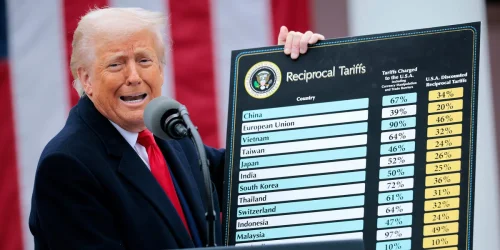
The United States Supreme Court has ruled that over $133 billion in tariffs imposed under former President Donald Trump were illegally collected, setting the stage for a protracted legal battle over refunds. The decision, delivered on Friday, struck down the centrepiece of Trump's trade policy, which was justified using the International Emergency Economic Powers Act (IEEPA).
Trump immediately criticised the ruling as "terrible" and "defective," while predicting the refund process "has to get litigated for the next two years." The US Secretary of the Treasury expressed scepticism that refunds would materialise, stating, "I've got a feeling the American people won't see it."
Legal Pathway to Reimbursement Remains Unclear
With no formal refund process yet established by the administration, claims are expected to flood the courts. Over 1,000 companies, from small importers to corporations like Toyota and Costco, have already filed lawsuits seeking reimbursement. Professor Rachel Brewster of Duke Law School notes that without an administrative process from Customs and Border Protection (CBP)—the agency that collected the tariffs—each claim will likely be litigated individually in the Court of International Trade.
Justice Brett Kavanaugh, in a dissenting opinion, warned the situation could become a "mess," citing refund requests totalling "billions of dollars to importers." He noted a key complication: many importers have already passed the tariff costs on to consumers.
Historical Precedent Points to Lengthy Resolution
Legal experts point to the process following a 1998 Supreme Court decision that overturned a harbour maintenance tax as a likely model. Commercial litigator Daniel Mach of Bryan Cave stated, "Everyone's going to be kind of figuring out the ropes as they go. But at the end of the day, it's not an unsolvable problem."
Given the volume of claims, the Court of International Trade is likely to appoint a special master or administrator to handle them collectively, rather than case-by-case. Advocacy groups, including the National Retail Federation, have urged the court to develop an efficient process, arguing refunds would provide "an economic boost" for companies to reinvest.
Consumers Face Uphill Battle for Refunds
While individuals who paid tariffs on personal imports are theoretically entitled to refunds, the path is fraught. Professor Brewster explains that claimants must distinguish between tariffs levied under the overturned IEEPA and those justified by other, still-valid laws. For small individual orders from retailers like Temu or Shein, legal costs would likely exceed any refund, though a class-action lawsuit remains a possibility.
"It was an illegally imposed tax," Brewster said. "So in theory, everyone is entitled to a refund." The entire process, whether handled by CBP or through the courts, is estimated by experts to take up to two years to resolve.