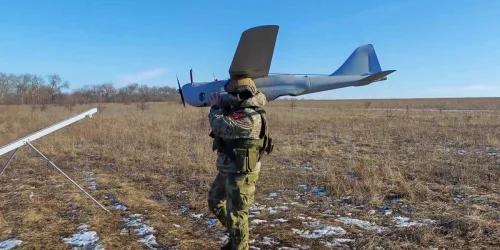
Imagine a silent, high-flying scout. Now, imagine it opening its wings to unleash a swarm of deadly, precision-guided kamikaze drones directly over enemy lines. This isn't science fiction. It's the terrifying new reality on the Ukrainian battlefield, and it could rewrite the rules of modern combat.
Ukrainian intelligence has just revealed photographic proof: Russia is turning its trusted Orlan reconnaissance drones into flying aircraft carriers. The implications are chilling. This single innovation could extend the lethal reach of Russia's most feared battlefield weapon, the First-Person-View (FPV) drone, by hundreds of miles.
From Scout to Superweapon: The "Orlan Mothership" Exposed
Serhii "Flash" Beskrestnov, a key drone advisor to Ukraine's defence ministry, dropped the bombshell images on Telegram. They show a fixed-wing Orlan drone—a workhorse of Russian surveillance—with FPV quadcopters mounted directly under its wings. "This time Orlan got on camera. He has already dropped one FPV," Beskrestnov wrote.
This isn't Russia's first attempt. They've previously experimented using disposable, one-way attack drones like the Shahed as carriers. But the Orlan is different. It's a reusable platform. An Orlan-10 can patrol for hours and fly pre-programmed missions up to 370 miles. By using it as a mobile launchpad and signal relay, Russian operators could potentially guide their explosive FPV drones to targets previously considered safe from such attacks.
Why This Changes Everything for Soldiers on the Ground
Until now, the brutal effectiveness of FPV drones has been limited by their range and the need for a clear radio signal from the pilot. The maximum recorded strike distance is about 40 miles. The "mothership" tactic shatters that limit.
Think of it this way: it turns a regional reconnaissance asset into a long-range strike system. A single Orlan could lurk deep behind friendly lines, then dispatch its lethal payload to hit command centres, supply depots, or air defence systems dozens of miles beyond the front. It creates a persistent, looming threat from the skies that is harder to predict and counter.
The Innovation Arms Race No One Saw Coming
Ukraine is fighting fire with ingenuity. Soldiers told Business Insider last November that Russia was already testing similar ideas with other drones. In response, Ukraine has pioneered its own "relay drones" to extend the range of their strikes. This conflict has become a laboratory for cheap, devastating innovation, where troops constantly merge simple technologies for maximum effect.
However, Beskrestnov cautions that the tactic is still emerging. "According to my observations, this technique has not been widely used by the enemy for a number of reasons," he noted. The challenge isn't just launching the FPVs, but ensuring reliable mid-air release and control—a complex feat of engineering performed in a warzone.
Yet, the genie is out of the bottle. The proof of concept is there, photographed on the battlefield. The era of the disposable, attritable drone is evolving into the age of the drone carrier. For every soldier on the front line, the sky just became a lot more dangerous.