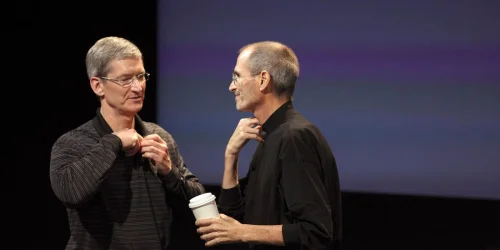
What happens when a company loses its legendary, visionary founder? For Apple, the answer was a quiet, operations-focused executive named Tim Cook. And the tech world held its breath, convinced the magic was gone for good.
But the story that unfolded over the next 15 years didn't just prove the doubters wrong—it shattered Silicon Valley's most sacred belief. The idea that only a founder can build something truly monumental? Tim Cook just spent over a decade burning that theory to the ground.
The "Loser" Label and a Pair of Green Trousers
In late 2013, with Apple seemingly adrift, Cook was labelled a "loser" in a major US newspaper roundup. The concern was palpable: could a supply chain specialist possibly innovate like Steve Jobs?
The tension even spilled into a face-to-face meeting. When a journalist—the same one who had called him a loser—arrived in bright green trousers, Cook quipped if he'd "just come from the golf course," drawing laughter from Dr. Dre and others in the room. It was a pointed, memorable moment of deflection.
But the real answer to the industry's doubts was already taking shape, hidden in plain sight.
The Masterstroke That Even Steve Jobs Might Not Have Made
The turning point wasn't a flashy new iPhone, but a massive $3 billion acquisition of Beats Electronics in 2014. When asked if Steve Jobs would have done such a deal, Cook gave a revealing answer.
He said he tried not to constantly ask "what would Steve do?" while still upholding the ethos of obsessive product excellence. It was a declaration of independence. He wasn't trying to be Steve; he was building Apple's future, his way.
That Beats deal was the seed. It gave Apple the foundation for Apple Music, launching the company's now-colossal services empire—a business that today generates over $100 billion in highly profitable revenue every year.
The "Unheard-of Scale" of a Non-Founder's Precision
Cook's operational genius turned Apple into a financial behemoth. Under his watch, Apple's market cap soared from around $350 billion to over $3 trillion. He added about $3.65 trillion in value—almost twice what Jobs had during his tenure.
"Tim and team have done a masterful job of continuing to develop Steve's vision while bringing operational and environmental excellence to every part of Apple's business," said Tony Fadell, the iPod's designer.
Former iPhone designer Matt Rogers put it simply: "Tim Cook scaled Apple into the company it is today. The world-changing scale is very much because of his leadership."
The Final, Unanswered Question of His Reign
Was Cook as *innovative* as Jobs? The record is mixed. Projects like the self-driving car were scrapped, and the Vision Pro headset has been a pricey flop. Critics now ask if Apple is behind in the AI race.
But Cook's legacy might be one of ruthless, calculated patience. While rivals spend hundreds of billions on AI infrastructure, Apple has so far avoided that massive capital expenditure. That restraint could yet become his final, strategic victory.
The market's verdict, however, is already in. Apple stands as one of the two or three most valuable companies on Earth. And in a stunning twist, it's now roughly tied with Google—a company also run for over a decade by a non-founder, Sundar Pichai. Cook didn't just succeed; he quietly rewrote the rulebook for every leader who follows.