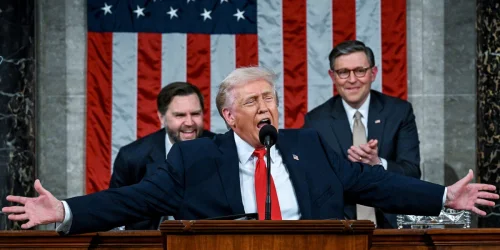
President Donald Trump has described the US Supreme Court's decision to strike down his signature tariffs as "unfortunate". He made the remarks during his State of the Union address, days after the court ruled against most of his 2025 tariffs enacted under the International Emergency Economic Powers Act (IEEPA).
In response to the legal setback, Trump immediately signed an executive order to impose a new 10% "global tariff" using Section 122 of the Trade Act of 1974. This provision allows duties to last for 150 days before requiring congressional approval, unlike the IEEPA powers.
New Tariff Mechanism and Economic Claims
"They're a little more complex, but they're actually probably better, leading to a solution that will be even stronger than before. Congressional action will not be necessary," Trump said of the new tariffs. He claimed the system would be "time-tested and approved" and suggested tariffs could "substantially replace the modern-day system of income tax".
Despite the court ruling against his primary negotiating tool, Trump asserted he would not need to make new trade deals because other countries were "happy with the deals made so far". US Customs and Border Protection data shows approximately $129 billion was collected under the now-overturned IEEPA tariffs.
Economic Impact and Consumer Sentiment
The Supreme Court's landmark ruling comes amid widespread economic concerns. While the US economy grew 2.2% in 2025, job creation has stalled, a pattern economists say is widening wealth inequality.
Multiple studies indicate tariffs are largely paid by domestic companies and consumers. A Federal Reserve Bank of New York report concluded that 90% of the tariffs' economic burden fell on US firms and consumers. Companies like FedEx have begun litigating for tariff refunds at the Court of International Trade.
Public opinion reflects this strain. A February poll by ABC News, The Washington Post, and Ipsos found a majority of Americans disapprove of the president's handling of inflation, tariffs, and the economy. Furthermore, the University of Michigan's consumer sentiment survey for February shows confidence is more than 12% lower than in February 2025.
Expert Analysis and Outlook
Dana M. Peterson, Chief Economist at The Conference Board, noted in February's economic sentiment research that while consumers' pessimistic future expectations "eased somewhat," confidence remains "well below" the peak seen in November 2024.
The legal and financial fallout from the overturned tariffs is now beginning, with companies seeking refunds. The new Section 122 tariffs provide a 150-day window for the administration, after which congressional approval would be required to extend them.