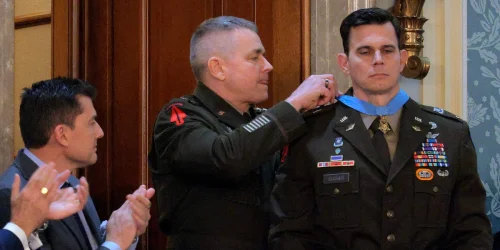
President Donald Trump shared vivid new details of a US military raid into Venezuela last month during his State of the Union address on Tuesday night, as he awarded the nation's highest military honour to two servicemen. The ceremony, which included a centenarian Navy pilot from the Korean War, drew mixed reactions for its politically charged timing.
The president described the moment a Chinook helicopter, piloted by Chief Warrant Officer 5 Eric Slover, approached the compound of then-Venezuelan President Nicolás Maduro on January 3. "Enemy machine guns fired from every angle," Trump said, revealing that Slover was "hit very badly in the leg and hip" during the assault.
Intense Firefight Over Caracas
Trump provided the most detailed public account yet of the injuries sustained during the operation, which he had previously only said left "a couple of guys hit." He stated that after American warplanes suppressed Venezuela's air defences, Slover's helicopter encountered two surviving machine gunners.
"He absorbed four agonizing shots, shredding his leg into numerous pieces," the President told the assembled crowd. "He was gushing blood." Despite his critical wounds, Slover reportedly manoeuvred the dual-rotor Chinook so its onboard gunners could "eliminate the threat," an action Trump credited with preventing "a catastrophic crash, deep in enemy territory."
After landing, Slover told his wounded co-pilot to "take over," stating, "I'm about ready to pass out." A total of seven US troops were injured during the raid.
A Second Honour for a Century-Old Pilot
The president also presented the Congressional Medal of Honor to 100-year-old US Navy pilot E. Royce Williams, a veteran of World War II, Korea, and Vietnam. Williams was originally awarded the Navy Cross for "extraordinary heroism" in a 1952 Korean War dogfight, a battle that remained classified for decades.
Flying an F9F Panther, Williams was outmatched by Soviet MiG-15 fighters but managed to shoot down four of them. The upgrade of his Navy Cross to the Medal of Honour is an example of the award's notoriously lengthy approval process, which can take years or even decades and requires strict eyewitness verification.
Controversy Over Ceremony's Setting
The decision to award the medals during the politically charged State of the Union address sparked debate. The Congressional Medal of Honor is traditionally bestowed in more solemn ceremonies at the White House. Some veterans online expressed concern that the setting diminished the gravity of the award.
The military's awards manual states the top honour is for troops engaged against an enemy of the US or an "opposing foreign force." During the event, Trump made a personal remark, stating, "I've always wanted the Congressional Medal of Honor, but I was informed, I'm not allowed to give it to myself."