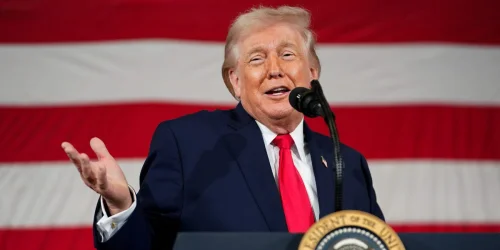
President Donald Trump delivered his annual State of the Union address to a joint session of Congress, opening with a focus on his administration's economic agenda. He framed his tenure as a rescue mission for a stagnant nation, now transformed into the world's "hottest" economy.
The speech highlighted efforts to curb inflation, reduce mortgage and energy prices, and create construction jobs. Trump also cited the strong stock market and claimed a record number of Americans had been removed from food stamps due to updated SNAP rules.
Claims of Economic Revival
"I inherited a nation in crisis with a stagnant economy," President Trump told lawmakers. He asserted his policies had driven down key cost-of-living indicators. "A short time ago, we were a dead country," he declared. "Now we are the hottest country anywhere in the world."
Throughout his second term, the White House has prioritised affordability, promoting measures like the One Big Beautiful Bill Act, tax breaks, and the recently launched TrumpRx prescription platform. On some issues, such as reining in credit card rates, the administration has collaborated on policies traditionally backed by Democrats.
Contrasting Data and Challenges
Despite the president's optimistic portrayal, economic data presents a mixed picture. Job market growth has been the lowest in decades outside of recession periods. Furthermore, Trump's Department of Government Efficiency has undertaken significant cuts to the federal workforce.
A YouGov and MarketWatch poll published on February 24 found that 83% of Americans believe affordability has either worsened or remained stagnant under Trump's second term, contradicting the administration's narrative of broad economic improvement.
Future Economic Strategy
Looking ahead, the administration is banking on a change in monetary policy to stimulate growth. It hopes the pending appointment of former Wall Street figure Kevin Warsh to replace Federal Reserve Chair Jerome Powell will lead to lower interest rates by 2026. This move is intended to boost hiring, though it carries the potential risk of reigniting inflation.
The lengthy speech, expected to last at least two hours, was also set to cover the Supreme Court tariff ruling, AI investment, immigration, and foreign policy.