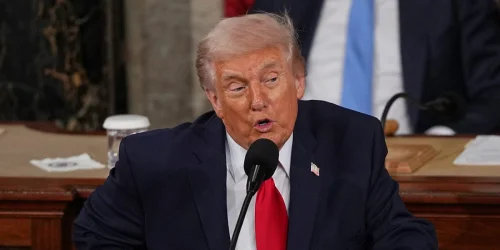
President Donald Trump delivered his annual State of the Union address on Tuesday, delivering a two-hour speech to a joint session of Congress that was the longest in US history. The address, light on new policy, heavily focused on reiterating his administration's economic agenda and outlining proposals on energy and taxation.
Trump used the platform to blame Democratic lawmakers for persistent inflation and to champion his tariff strategy as a major revenue source. The speech was attended by several Supreme Court Justices, including some who had recently ruled against his tariff policies.
Economic Agenda and Tax Proposals
Central to the address was a defence of Trump's economic record. "Now we are the hottest country anywhere in the world," the President stated, claiming his policies have lowered costs for housing, healthcare, and energy. He specifically promoted his One Big Beautiful Bill Act and Trump Accounts, a plan for tax-free investment accounts.
He proposed several tax relief measures aimed at households, including no tax on tips or overtime, a tax incentive for buying American-made cars, and the aforementioned investment accounts. Trump framed affordability as an income-side issue to be solved through tax cuts rather than direct price controls.
Tech Giants Told to 'Build Their Own Power Plants'
A significant new proposal targeted the technology sector. Trump warned that energy demands from artificial intelligence data centres could "unfairly" increase utility costs for Americans. He announced a "rate-payer protection pledge" requiring major tech companies to provide for their own power needs.
"They can build their own power plants as part of their factory so that no one's prices will go up," Trump said, citing the US's "old grid" as insufficient for future demands. The move shifts the infrastructure burden for power-intensive industries away from public utilities.
Tariffs Touted as Revenue Engine
Trump vigorously defended his administration's use of tariffs, calling them a diplomatic tool and a revenue generator bringing in "hundreds of billions of dollars." He suggested this revenue could "substantially replace the modern-day system of income tax."
This praise came despite a recent "disappointing" and "unfortunate" Supreme Court ruling that blocked his sweeping tariff policy. Chief Justice John Roberts and Justices Elena Kagan and Amy Coney Barrett, who attended the speech, had voted in the majority against the tariffs.
Military Budget and Bipartisan Moment
The President confirmed the approval of a trillion-dollar military budget for the coming year, stating "we have no choice" but to maintain the most powerful military on earth. This figure is lower than the $1.5 trillion he suggested on his Truth Social platform in January, which he said would be financed by tariff revenue.
A rare moment of bipartisan agreement occurred when Trump voiced support for the GOP-sponsored Stop Insider Trading Act. The bill, introduced by Rep. Bryan Steil of Wisconsin, would restrict stock trading by lawmakers and their spouses. Trump noted he was "impressed" by Democratic applause for the measure.