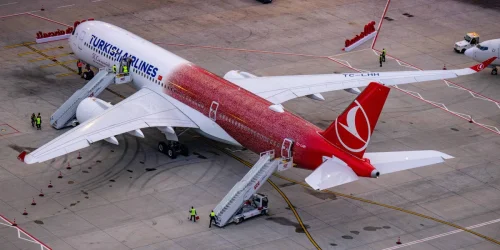
Turkish Airlines has revealed a one-of-a-kind Airbus A350-900 aircraft adorned with a decal featuring the faces of 100,000 current and former employees. The unique livery was created to mark the delivery of the carrier's 500th aircraft, with the plane operating a special flight numbered TK500 that traced the number "500" in the sky.
The project, which required extensive in-house collaboration, took approximately one year to plan. Applying the massive graphic, made from roughly 300 pounds of high-grade aviation sticker material, was completed over five days. A spokesperson for the airline stated that staff have enjoyed trying to spot their own faces on the aircraft.
Decals Offer Practical Advantages Over Paint
Airlines increasingly use specialised decals for special liveries as they are lighter than paint, reducing fuel burn, and can be applied and removed more quickly. They are also better suited for intricate, multi-coloured designs. For this project, employee photographs were adjusted to match Turkish Airlines' brand colours of white, red, and black, using multiple shades of red to create visual depth.
Precision application was critical, involving detailed 3D modelling to fit the faces around doors, windows, and the aircraft's curved surfaces. Misalignment could create aerodynamic issues. The decals are protected by a clearcoat to withstand harsh flight conditions at 35,000 feet, including UV exposure, extreme temperatures, and de-icing fluid.
A Global Trend of Flying Billboards
Turkish Airlines joins numerous global carriers that use aircraft as flying billboards for marketing and brand storytelling. Other examples include United Airlines' Star Wars-themed plane, various Asian carriers' Pokémon jets, Southwest Airlines' Disney aircraft, and an Emirates Airbus A380 wrapped with a decal of Real Madrid footballers.
While decals are common for temporary or complex designs, some airlines opt for full paint jobs. These are more time-consuming and costly. Industry estimates place paint job costs between $50,000 and $300,000 per aircraft, while decals typically cost in the low tens of thousands. A China Airlines "Pikachu Jet" required 36 paint types and 21 days of work, while a complex Qantas A220 livery needed 100 painters to apply over 20,000 unique dots.
Strategic Marketing Payoff
Investing in unique liveries is a strategic marketing move for airlines. The payoff can come in the form of new customers, significant social media buzz, or revenue from sponsorships tied to the special design. The Turkish Airlines project, celebrating its workforce and fleet milestone, is designed to strengthen brand identity and employee morale.
The specially liveried Airbus A350 will now enter the airline's regular commercial service, continuing to serve as a flying tribute to the staff who have contributed to the carrier's growth over decades.