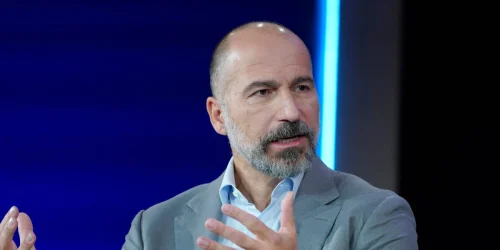
Employees at Uber have developed an artificial intelligence clone of the company's chief executive, Dara Khosrowshahi, to help them prepare for high-stakes meetings with him. The CEO revealed the practice on a recent episode of 'The Diary of a CEO' podcast, hosted by Steven Bartlett.
Khosrowshahi explained that teams use the "Dara AI" to rehearse their presentations, allowing them to tune their slides and arguments based on the AI's simulated feedback. This internal tool represents a novel application of generative AI within corporate culture, moving beyond operational tasks into executive preparation.
AI as a Corporate Rehearsal Tool
While the exact prevalence of the CEO bot across Uber's offices is unclear, its existence highlights how employees are leveraging AI to navigate workplace pressures. "They basically make the presentation to the Dara AI as a prep for making a presentation to me," Khosrowshahi stated. He added that the clone helps staff "tune their prep" before the actual meeting.
This practice raises broader questions about AI's potential ascent within corporate hierarchies. Google CEO Sundar Pichai has previously suggested that AI could eventually replace CEOs, a notion echoed in the podcast's discussion. When asked by host Bartlett if he was concerned the AI might be shown to Uber's board, Khosrowshahi laughed off the suggestion.
The Limits of AI and the Future of Work
Despite its utility, Khosrowshahi pointed to a critical limitation of current AI models: their inability to process and make decisions based on entirely new information in real-time. "When the models can learn in real-time, that is the point at which I'm going to think that, yeah, we are all replaceable," the Uber CEO said.
Uber's business is deeply integrated with AI, from optimising its ride-hailing platform to a dedicated AI Solutions division that pays contractors to train models for clients. Khosrowshahi noted that about 30% of Uber's software engineers are "power users" of AI tools.
Efficiency Gains and Headcount Implications
The CEO outlined a dual potential impact on jobs. If AI makes engineers 25% more efficient, his instinct would be to "hire more engineers, because I want to go faster." However, he acknowledged an alternative path where increased efficiency does not lead to more hiring.
"I may not decide to add engineering headcount," Khosrowshahi said. "At that point, instead of adding an engineer, I should add agents and buy some more GPUs from Nvidia." This statement underscores the ongoing corporate calculation between human labour and automated systems.