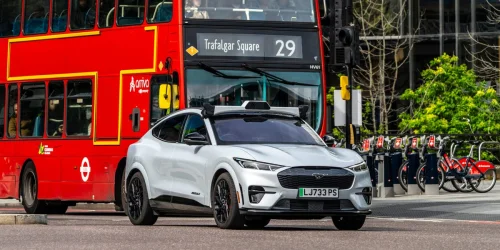
Wayve, a British autonomous vehicle software startup, has secured $1.5 billion in new funding from a consortium of major technology and automotive companies. The investment, announced on Tuesday, values the company at $8.6 billion and is led by Microsoft and Nvidia, with significant contributions from Uber, Mercedes-Benz, Nissan, and Stellantis.
The capital injection will accelerate Wayve's ambition to license its artificial intelligence driving software to global automakers and robotaxi platforms, beginning with a deployment on Uber's service in London later this year. The deal with Uber envisions expanding the partnership to over 10 markets worldwide.
Funding Fuels Global Ambition
The $1.5 billion round includes $1.2 billion from the core investor group and additional capital from Uber tied to the global deployment of Wayve-powered vehicles. "We've been learning to drive on British roads for the last eight years, and so this is our home turf," said Wayve's co-founder and CEO, Alex Kendall, in an interview.
Kendall stated the funding is pivotal for the company's business model, which focuses solely on developing AI driver software rather than manufacturing vehicles or operating its own robotaxi fleet. He argued that owning a fleet is prohibitively expensive and that building a proprietary car, like Tesla, limits a company to a single vehicle platform. "Everyone wants autonomy, but not everyone wants to buy a Tesla," Kendall told Business Insider.
A Different Approach to Autonomy
Wayve's technology is designed to be a "generalizable" AI driver, capable of adapting to different cars, sensor configurations, and new cities without relying on pre-mapped, high-definition routes. This approach contrasts with rivals like Alphabet's Waymo, which uses detailed maps and sensor suites.
The company claims its AI, tested in Ford Mustang Mach-E vehicles, has successfully driven in over 500 cities across Europe, North America, and Japan without prior city-specific training. This adaptability allows the software to learn new road rules, such as switching which side of the road to drive on.
Competitive Landscape in London
Wayve's public debut comes as the race for robotaxis in London heats up. Waymo, the industry leader from the United States, aims to begin operations in the UK capital this year, marking its first international expansion. Meanwhile, Chinese tech giant Baidu is also partnering with ride-hailing firm Lyft to bring its autonomous vehicles to the market.
Beyond robotaxis, Wayve plans to license its technology to carmakers for advanced driver-assistance systems (ADAS). It has an agreement with Nissan to power the Japanese automaker's ProPilot system from 2027, positioning it as a competitor to Tesla's Full Self-Driving capability.