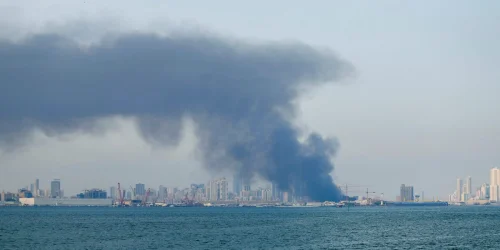
The United States and Israel launched a joint military operation against targets in Iran on Saturday, February 28, in what the Pentagon has termed a "preemptive" strike codenamed "Epic Fury". In retaliation, Iranian forces have claimed strikes against a US naval base in Bahrain and launched attacks across the region.
The offensive comes at a critical juncture, as diplomatic efforts between US and Iranian officials regarding Iran's nuclear programme were reportedly underway. The simultaneous explosions heard in Tehran mark a significant and dangerous escalation in long-standing regional hostilities.
Operation "Epic Fury" and Immediate Fallout
According to official statements, the US-Israeli operation was a coordinated air campaign. The Pentagon confirmed the action was a defensive measure, though specific targets within Iran were not immediately disclosed. Satellite imagery and regional defence monitors reported multiple launch sites being activated from allied bases.
In a swift response, the Islamic Revolutionary Guard Corps (IRGC) announced it had struck the US Naval Support Activity Bahrain, a key Fifth Fleet headquarters. "Our forces have responded decisively to the aggression," an IRGC statement read, adding that further retaliatory strikes were conducted against "interests of the attacking forces" elsewhere in the Middle East.
Diplomatic Context Shattered
The military action directly interrupts a fragile diplomatic channel. For months, indirect talks facilitated by European powers had sought to revive the 2015 nuclear deal, known formally as the Joint Comprehensive Plan of Action (JCPOA). A senior State Department official, speaking on condition of anonymity, stated the talks were "in a sensitive phase" prior to the attacks.
Analysts warn this exchange of blows could collapse negotiations entirely, pushing Iran to accelerate its uranium enrichment activities in defiance of international oversight. The UN's International Atomic Energy Agency (IAEA) had recently reported increased stockpiles of highly enriched uranium at Iranian facilities.
Regional Security on High Alert
Neighbouring Gulf states, including Saudi Arabia and the United Arab Emirates, have called for "maximum restraint". Both nations, while historically wary of Iran's influence, have recently pursued détente with Tehran and fear being drawn into a broader conflict. Commercial air traffic over the Persian Gulf was temporarily diverted, and global oil prices surged by over 8% in early trading.
The US Central Command (CENTCOM) has placed all forces in the region at Force Protection Condition "Delta", its highest state of alert. The UK's Royal Navy has been instructed to accompany UK-flagged vessels through the Strait of Hormuz, a critical chokepoint for global oil shipments.
What Happens Next?
The immediate focus is on de-escalation, though avenues appear limited. The UN Security Council is scheduled for an emergency session. US Secretary of State is expected to brief NATO allies, while Israel's war cabinet remains in continuous session.
The risk of a prolonged tit-for-tat conflict is high. Further Iranian proxy attacks on US forces in Iraq and Syria are considered likely, as is increased harassment of shipping in the Red Sea by Houthi forces in Yemen, who are backed by Tehran. The situation remains fluid and highly volatile.