The United States and Israel have launched a massive, coordinated military operation against Iran, striking hundreds of targets across the country. The operation, which began on Saturday, involves precision munitions launched from air, land, and sea, and is described by US Central Command (CENTCOM) as involving "the largest regional concentration of American military firepower in a generation."
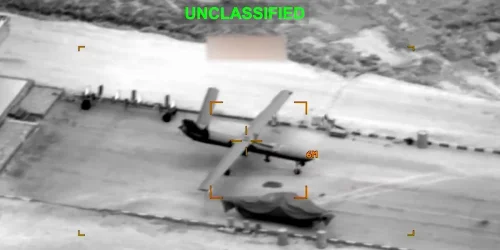
US Central Command released video footage showing elements of the strikes, including destroyers firing missiles and carriers launching combat aircraft. The footage also shows repeated strikes on Iranian military targets. CENTCOM stated its forces are "delivering an overwhelming and unrelenting blow" with the objective to "defend the American people by eliminating imminent threats from the Iranian regime."
Scale and Scope of the Attacks
The Israel Defense Forces (IDF) said it used around 200 fighter jets in what it described as "the largest military flyover in the history of the Israeli Air Force." The jets dropped hundreds of munitions "targeting approximately 500 objectives, including aerial defense systems and missile launchers, in a number of locations in Iran, simultaneously." Israel has also released its own footage showing an attack on missile launchers at a remote site.
A US official told Business Insider that the US launched Tomahawk cruise missiles from warships and that ground forces used the High Mobility Artillery Rocket System (HIMARS). Other weapons were also employed. The operation is dubbed "Operation Epic Fury" on the American side and "Roaring Lion" on the Israeli side.
Targets and Iranian Response
US Central Command said targets included "Islamic Revolutionary Guard Corps command and control facilities, Iranian air defense capabilities, missile and drone launch sites, and military airfields." Strikes have been reported across Iran, including at military sites and the residence of Iran's supreme leader. Satellite imagery showed a burning Iranian warship in the aftermath of the initial strikes.
In response, Iran launched counterattacks against Israel and multiple nearby nations, many of which host US forces. CENTCOM said its forces successfully defended against hundreds of Iranian missile and drone attacks, sustaining minimal damage that did not impact operations. Bahrain reported the headquarters of the US Navy's 5th Fleet was hit by an Iranian missile.
Human Cost and Regional Fallout
Iranian officials said at least 85 people were killed at a girls' elementary school. The Iranian Red Crescent humanitarian group told the BBC that 201 people had been killed in the country overall.
Iran's strikes also targeted Kuwait, the United Arab Emirates (UAE), Qatar, and Jordan. Kuwait reported three armed forces members sustained minor injuries from interception debris. The UAE said one person was killed by falling debris in its capital, Abu Dhabi, and four were injured in an incident in Dubai.
Political Reactions and Future Implications
Iran's Foreign Minister, Abbas Araghchi, called the US and Israeli strikes "wholly unprovoked, illegal, and illegitimate." Iran has vowed further action. Both Israel and the US have indicated their actions so far may only represent the beginning of the operation.
The conflict has caused major regional disruption, with flights cancelled and multiple countries closing their airspaces, affecting one of the world's busiest flight routes.