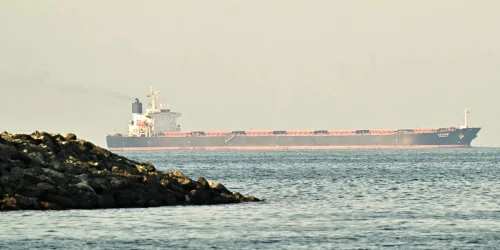
Military strikes by the United States and Israel on Iran have plunged global supply chains into turmoil, causing immediate and widespread disruption across one of the world's most critical trade corridors. The escalation over the weekend has forced shipping giants to halt services and reroute vessels, with air cargo networks also buckling under sudden airspace restrictions. The conflict threatens to prolong the severe trade disruptions already caused by Houthi attacks in the Red Sea.
Peter Sand, chief analyst at freight-rate analytics platform Xeneta, stated that while container services had continued unaffected by the prior military build-up, "the escalation in conflict through military strikes means ships will now avoid the area, but for as short a time as possible." The immediate operational fallout is extensive, impacting the movement of consumer goods, auto parts, electronics, and food.
Shipping Giants Halt Operations and Impose Surcharges
Mediterranean Shipping Company (MSC), the world's largest container line, suspended all cargo bookings to the Middle East on Sunday. Danish giant Maersk has paused Red Sea and Suez Canal transits, rerouting its vessels around the Cape of Good Hope in South Africa amid fears the conflict could spill over into key lanes.
French carrier CMA CGM announced an "Emergency Conflict Surcharge" of between $2,000 and $4,000 per container for shipments to and from Gulf and Red Sea countries, citing rising security risks. The company had previously ordered vessels in the Gulf to "proceed to shelter" and suspended Suez Canal sailings. Similarly, Germany's Hapag-Lloyd introduced a $1,500 per standard container war risk surcharge and suspended transits through the Strait of Hormuz.
Air Cargo Capacity Plummets Amid Airspace Closures
The disruption extends to the skies, where several Middle Eastern airspaces have been closed or restricted. Parcel delivery leader FedEx suspended flights to and from markets including Bahrain, Israel, Qatar, Saudi Arabia, Kuwait, and the UAE, halting pickup and delivery services in several Gulf countries. Qatar Airways Cargo temporarily suspended all operations due to the closure of Qatari airspace.
Logistics firm DSV warned that airspace restrictions are forcing carriers to suspend services or divert flights, lengthening routings. The company anticipates that with less cargo space on key Asia-Europe and Middle East routes, air freight rates will rise, space will tighten, and airlines may make short-notice schedule changes.
Long-Term Implications for Global Trade
The rerouting of container ships around Africa, rather than through the Suez Canal, is absorbing roughly 2.5 million twenty-foot equivalent units (TEUs) of global container capacity, according to Xeneta's analysis. Ryan Petersen, CEO of Flexport, wrote on social media platform X that the conflict has removed 18% of global air freight capacity from the market.
Peter Sand further warned that if carriers begin omitting Gulf port calls, containers may be discharged at alternative hubs and trucked onward. He concluded that the escalation "will see the further weaponization of trade and shatter hopes of a large-scale return of container shipping to the Red Sea in 2026," referencing the ongoing disruption from Iran-backed Houthi attacks on commercial shipping over the past two years.