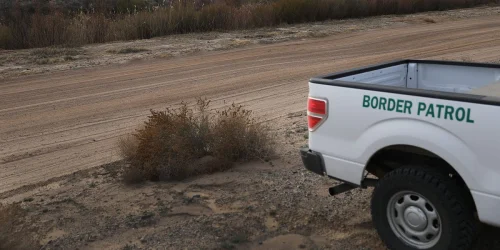
The United States military shot down a Customs and Border Protection (CBP) drone over Texas on Thursday, 12 June, according to a joint statement from three senior Democratic lawmakers. The Federal Aviation Administration (FAA) has expanded a temporary flight restriction around Fort Hancock, Texas, citing "special security reasons."
The incident involved the Department of Defense using a "high-risk counter-unmanned aircraft system" to bring down the federal border agency's drone. The statement was issued by Representative Rick Larsen of Washington, Representative Bennie Thompson of Mississippi, and Representative André Carson of Indiana, who lead key House committees on Transportation and Homeland Security.
Lawmakers Blame Policy Failure
In their statement, the lawmakers directly linked the incident to a previous political dispute. "We said months ago that the White House's decision to sidestep a bipartisan, tri-committee bill to appropriately train C-UAS operators and address the lack of coordination between the Pentagon, DHS, and the FAA was a short-sighted idea," they stated. "Now, we're seeing the result of its incompetence."
The term "counter-unmanned aircraft system" (C-UAS) often refers to anti-drone technologies such as directed-energy lasers. The lawmakers did not specify the exact system used in Thursday's incident.
Airspace Restrictions and Precedent
The FAA confirmed to *Business Insider* that it expanded an existing temporary flight restriction (TFR) around Fort Hancock "to include a greater radius to ensure safety." The agency stated commercial flights would not be affected. This restriction is scheduled to remain in effect until 24 June.
This event follows a similar incident over El Paso, Texas, two weeks prior. The New York Times reported that earlier closure was prompted by the downing of a party balloon, which also involved an anti-drone laser. The El Paso TFR was initially set for 10 days but was lifted after only a few hours.
Unanswered Questions and Official Silence
It remains unclear precisely when the Fort Hancock incident occurred or if the expanded airspace closure is directly related. As of Friday morning, neither the Customs and Border Protection agency nor the Pentagon had responded to requests for comment sent outside regular business hours.
The statement from the Democratic committee leaders underscores ongoing concerns about inter-agency coordination and the protocols for deploying advanced counter-drone technology within US domestic airspace, particularly in sensitive border regions.