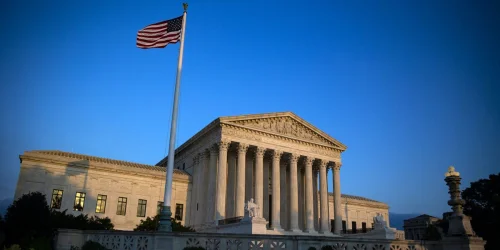
The United States Supreme Court has struck down the majority of former President Donald Trump's tariff policies, ruling on Friday that he lacked the statutory authority to enact them under the International Emergency Economic Powers Act (IEEPA). The landmark decision directly invokes the same legal reasoning the court used to block President Joe Biden's broad student-loan forgiveness plan in 2023.
In a 6-3 ruling, the court found that the Trump administration's use of IEEPA to impose sweeping tariffs on imported goods exceeded the powers granted by Congress. Chief Justice John Roberts, writing for the majority, stated that such significant economic actions require clear and specific congressional authorisation, a principle known as the "major questions doctrine."
Parallel to Student-Debt Ruling
The court explicitly linked its reasoning to the 2023 case Biden v. Nebraska, which invalidated a plan to cancel approximately $430 billion in federal student loan debt. Justice Neil Gorsuch, in a concurring opinion, noted the court consistently demands "clear congressional authorization" for policies of vast economic and political significance, whether they involve tariffs or debt relief.
Chief Justice Roberts wrote that the government's defence in the tariff case was "nearly identical" to its failed argument in the student-loan case. He rejected the administration's claim that emergency statutes should be interpreted broadly to grant the executive "substantial discretion" during crises.
The Core Legal Argument
The major questions doctrine holds that federal agencies cannot decide issues of major national significance based on vague or ambiguous congressional authority. Roberts stated that while IEEPA allows the president to regulate some economic activity during declared emergencies, it does not constitute a clear delegation of power to unilaterally reshape national trade policy through extensive tariffs.
This mirrors the court's 2023 finding on the HEROES Act of 2003. While that law allowed the Secretary of Education to "waive or modify" student-loan provisions during emergencies, the court ruled it did not authorise the mass cancellation of debt.
Reaction and Next Steps
Former President Trump criticised the ruling in public remarks, stating the justices should be "absolutely ashamed" and vowing to pursue "alternatives" to preserve his trade agenda. He clarified that "The Supreme Court did not overrule tariffs. They merely overruled a particular use of IEEPA tariffs."
Legal analysts suggest the decision reinforces significant constraints on executive power, requiring future administrations to seek explicit legislative approval for large-scale economic initiatives. The ruling does not prevent future tariffs but mandates they be grounded in specific, congressionally-approved statutes.