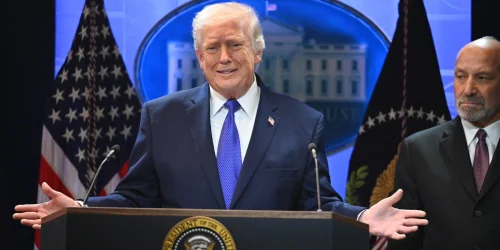
The US Supreme Court has ruled that former President Donald Trump's cornerstone 2025 tariffs were imposed illegally, dealing a major blow to his economic agenda. In a 6-3 decision, the court found on Friday that the president does not have the authority to impose tariffs using the International Emergency Economic Powers Act (IEEPA).
The ruling invalidates most of the tariffs Trump imposed in 2025, including the "reciprocal" tariffs and the 10% baseline duties. The decision immediately shifts focus to the complex legal battle over potential refunds, which could amount to $129 billion paid by over 301,000 importers.
Legal and Financial Fallout Begins
President Trump stated on Friday that the US government will not make immediate refunds, as the Supreme Court did not explicitly order them. He suggested the matter could "end up in court for the next five years." This sets the stage for protracted litigation as businesses seek to reclaim paid duties.
International trade lawyer Joyce Adetutu of Vinson & Elkins told Business Insider that a refund of this magnitude is "unprecedented" and the process will be "daunting." She advised importers to immediately gather documentation and prepare for protests and litigation.
Ryan Petersen, CEO of logistics firm Flexport, noted on social media that trade attorneys could charge clients 15% of the refund amount to help them claim it.
Political Demands and Economic Impact
Democratic lawmakers have seized on the ruling to demand tariff refunds for households. California Governor Gavin Newsom stated, "Donald Trump should return that money immediately. He has an obligation... He took hundreds of billions of dollars from working folks."
Illinois Governor JB Pritzker sent Trump an "invoice" demanding a $1,700 refund for every family in Illinois.
The Committee for a Responsible Budget estimated the ruling could reduce federal revenues by $1.9 trillion through 2036 and increase national debt by $2.4 trillion, assuming full refunds without replacement revenue.
Consumer Prices and Ongoing Tariffs
While the ruling may ease inflationary pressures, analysts warn price cuts may not be immediate. Research from the New York Fed found that 94% of tariffs were paid by domestic businesses and consumers in 2025, exerting "measurable upward pressure" on prices.
Josh Ketter, CEO of major importer Spreetail, told Business Insider that retailers, having absorbed tariff costs, will likely use refunds to repair their margins first. "Their first priority for tariff refunds will be to make themselves financially whole again," he said.
Furthermore, tariffs are not completely eliminated. Trump signed a proclamation on Friday imposing new 10% tariffs for 150 days starting February 24 under Section 122 of the Trade Act of 1974, with exemptions for items like critical minerals.
Small Business Victory and Cautious Optimism
Small businesses that challenged the tariffs are celebrating. "It's impossible to describe the feeling of elation... a feeling that justice prevailed," said Victor Schwartz, lead plaintiff and owner of wine importer VOS Selections. His company has paid tariffs in the "low six figures."
However, Per Hong of Kearney Foresight cautioned against expecting rapid relief. "Any reimbursement process is likely to be administratively slow, burdensome, and likely drawn out over years," Hong stated.
Major corporations like Costco, Toyota, and Chinese EV maker BYD had already filed suits to preserve their right to refunds. Recovering duties that have already been processed through customs, or "liquidated," may require extensive additional litigation.