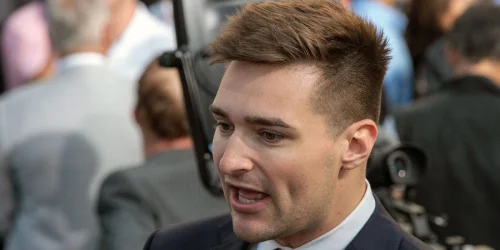
Alex Bruesewitz, a 29-year-old political operative with no formal White House role, has become a central figure in shaping former and current President Donald Trump's digital communication and cultural outreach strategy. Operating from his firm, X Strategies, Bruesewitz bridges the gap between the Trump administration and a network of celebrities, sports stars, and online influencers, aiming to reach audiences beyond traditional media.
His work, which includes managing key social media accounts and orchestrating high-profile podcast appearances for Trump, was instrumental in the 2024 campaign's gains among young male voters. However, recent polling indicates a significant decline in Trump's approval rating among younger Americans, presenting a new challenge for Bruesewitz's methods as the political landscape shifts.
From Online Provocateur to Political Insider
Bruesewitz's political journey began in his hometown of Ripon, Wisconsin. He first engaged with Trump's movement in 2015 and built a reputation as a fierce online defender and attacker within MAGA circles. His early work involved running social media for figures like Marjorie Taylor Greene and the father of a Parkland shooting victim.
Following Trump's 2020 election loss, Bruesewitz demonstrated loyalty by aggressively targeting Republican critics of the former president, including Representatives Liz Cheney and Adam Kinzinger. His tactics were described by Republican consultant Garrett Ventry as those of "always a knife-fighter."
Masterminding the 2024 Digital Playbook
Hired by the Trump-aligned super PAC MAGA Inc. for the 2024 cycle, Bruesewitz helped pivot the campaign's digital strategy. He focused on podcasts, meme culture, and vertical video to engage younger demographics, moving away from a reliance on platforms like Facebook.
He orchestrated Trump's appearance on popular shows like those hosted by Joe Rogan and Adin Ross, generating tens of millions of views. A video featuring wrestlers The Undertaker and Kane endorsing Trump amassed 36 million views on TikTok. "He's a cultural figure," Bruesewitz said of Trump. "That's what people miss."
This strategy contributed to a dramatic swing among men under 50, who backed Trump by 12 points in 2024 after supporting Joe Biden by 10 points four years earlier, according to Pew Research Center data.
The Challenge of Governing and Fading Influence
Since Trump's return to office, Bruesewitz has faced difficulties. The same online ecosystem that embraced an anti-establishment candidate has cooled towards an incumbent president. An Economist/YouGov poll shows Trump's approval rating among Gen Z voters has fallen to 24%.
Influencers who championed Trump in 2024 have publicly criticised his policies on issues like government spending and foreign wars. Comedian Andrew Schulz stated on his podcast, "He's doing the exact opposite of everything I voted for." Adin Ross, who interviewed Trump, said he lost over $10 million due to Trump's tariffs and is now unlikely to support a politician again.
Bruesewitz dismissed these critiques, telling POLITICO, "I don't think people really tune into them for political dialogue."
Blurring Lines Between Politics and Personal Brand
Bruesewitz declined a White House role as new-media director, choosing to remain at his consulting firm. This has led to scrutiny, such as a $300,000 contract with the American Rights and Reform PAC to advocate for cannabis reclassification, which caused consternation among some White House officials.
He continues to advise the administration informally while elevating his own profile. His recent black-tie wedding at Trump's Doral golf club, attended by celebrities like 50 Cent and Mike Tyson alongside political figures, was featured in the New York Post's Page Six.
White House communications director Steven Cheung acknowledged Bruesewitz's influence, stating, "He continues to advise many people within the White House and in Trump World, and his advice carries significant weight."
A Cultural Ambassador with an Uncertain Future
Bruesewitz's most recent coup involved orchestrating rapper Nicki Minaj's endorsement of the administration's "Trump Accounts" financial literacy program in January 2026. He facilitated her involvement after building a relationship based on shared concerns about violence against Christians in Nigeria.
Yet, his core challenge remains. As Bruesewitz himself noted, the podcasters and influencers crucial to his strategy primarily want to talk to figures who "transcend politics." He concluded, "The president is kind of the only person that does that," highlighting the potential fragility of the coalition he helped build once Trump is no longer on the ballot.