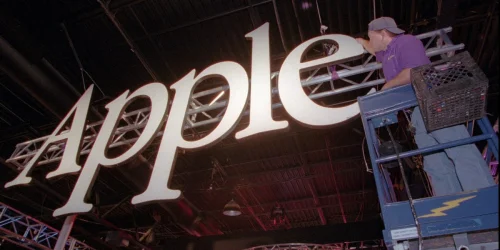
Apple Inc. has reached its 50th anniversary, a milestone commemorated with a series of global celebrations attended by public figures, company executives, and loyal fans. Founded on 1 April 1976, the company has evolved from a garage-based startup into one of the world's most valuable public companies, recently securing a $4 trillion market capitalisation in October 2025.
The anniversary events include presentations at Shanghai Fashion Week and live music performances. This celebration comes as Apple continues to launch new hardware, including the iPhone 17 series and the MacBook Neo, while facing significant challenges such as antitrust lawsuits and increased competition in key markets like China.
From Garage Startup to Trillion-Dollar Titan
Apple's origins trace back to the Los Altos garage of Steve Jobs' parents, where he and co-founder Steve Wozniak, alongside a third founder, Ronald Wayne, began the company. Wayne sketched the first Apple logo by hand but left the company before its official incorporation in 1977, taking an $800 cheque for his shares. The company's first product, the Apple I, was a motherboard kit hand-built by Wozniak for hobbyists.
The breakthrough came with the Apple II in 1977, a personal computer that gained widespread adoption partly due to the VisiCalc spreadsheet software. By 1978, Apple had moved into its first proper office with a production line. A pivotal moment occurred in 1979 when Apple engineers visited the Xerox PARC research centre, an experience that heavily influenced the development of the graphical user interface (GUI).
Leadership Turmoil and the Return of Jobs
The 1980s and 1990s were marked by internal conflict and market struggles. After the high-profile recruitment of Pepsi CEO John Sculley in 1983, tensions between Sculley and Steve Jobs culminated in Jobs' departure in 1985 following a failed boardroom coup. Jobs founded NeXT Computer, while Wozniak also left, selling most of his shares.
Under Sculley and his successors, Michael Spindler and Gil Amelio, Apple faced a series of commercial disappointments, including the expensive Newton MessagePad in 1993 and the challenging transition to PowerPC processors. By 1996, Apple's stock hit a 12-year low. In a strategic turnaround, CEO Gil Amelio purchased NeXT Computer for $429 million in February 1997, bringing Jobs back to the company. Jobs soon became interim CEO after Amelio's resignation.
Era-Defining Innovation and Market Dominance
Jobs' return heralded a period of radical innovation. In August 1997, he announced a $150 million investment from Microsoft, stating, "We need all the help we can get." This was followed by the launch of the iconic iMac in 1998, designed by Jony Ive. The company introduced Mac OS X in 2000 and transitioned to Intel processors in 2006.
The 2000s saw the launch of products that redefined entire categories: the iPod in 2001, the iPhone in 2007, and the iPad in 2010. Following Jobs' death in 2011, CEO Tim Cook oversaw the introduction of new product lines like the Apple Watch in 2015, AirPods, and services including Apple Music and TV+.
Contemporary Challenges and Future Direction
Apple's current era is defined by both continued success and significant headwinds. In January 2024, the European Commission forced Apple to open its iOS App Store to third-party marketplaces in the EU under the Digital Markets Act (DMA), challenging its tightly controlled ecosystem.
Concurrently, the company faces a major antitrust lawsuit from the US Department of Justice and 16 state attorneys general, accusing it of using anti-competitive tactics to dominate the smartphone market. Apple denies these allegations.
Market pressures are also evident, with iPhone sales in China dropping by 24% in the first six weeks of 2024 as competitors like Huawei gain share. Product reception has been mixed; the launch of the $3,499 Apple Vision Pro spatial computer in 2024 saw some users returning the device, citing issues with design and a lack of clear use cases.
In a significant strategic shift, Apple reportedly cancelled its multibillion-dollar "Project Titan" electric car venture in early 2026, reassigning nearly 2,000 employees to its artificial intelligence division.
Anniversary Launches and Financial Milestones
Amidst these challenges, Apple continues to innovate. In March 2026, it unveiled the MacBook Neo at a New York event. Priced at $599, it is $500 cheaper than the base M5 MacBook Air and was described by tech reviewer Marques Brownlee as "potentially Apple's most disruptive product in the last 10-plus years."
The company also launched the iPhone 17 series, featuring the A19 chip to power its new "Apple Intelligence" AI software. The iPhone 17 Pro boasts advanced camera capabilities, while the ultra-thin 5.6mm iPhone Air introduces a new "plateau" design. These models have helped Apple regain footing in the Chinese market.
Financially, Apple's journey has been historic. It became the first company to reach a $1 trillion valuation, later achieving a $2 trillion market cap just 24 months later. In October 2025, it joined Nvidia and Microsoft as only the third company ever to reach a $4 trillion valuation, cementing its status as a defining corporation of the modern technological age.