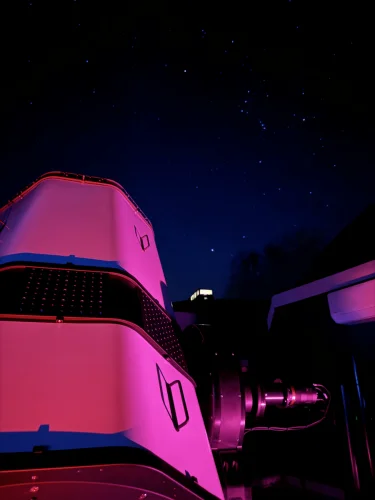
Imagine watching a crystal-clear 4K video, beamed live from astronauts orbiting the Moon. Now, imagine the key to receiving that signal wasn't a billion-dollar NASA facility, but a surprisingly cheap piece of kit set up in the Australian outback. That’s exactly what happened during the historic Artemis II mission, and it’s about to revolutionise how we talk to space.
While the world marvelled at the images, a quiet revolution in data transmission was taking place. A low-cost terminal, built by Observable Space and Quantum Opus and operated by the Australian National University, successfully pulled down data from the Orion spacecraft at a blistering 260 megabits per second. Its cost? Less than $5 million—a fraction of the price for traditional, bespoke ground stations.
The "Bargain Bin" Breakthrough That Outperformed Expectations
This wasn't just a lucky catch. The terminal used Observable Space's software and telescope to lock onto the laser transmissions, paired with a cutting-edge photonic sensor from Quantum Opus to decode the data. Its success during one of NASA's most watched missions proves a critical point: high-speed space-to-Earth links don't have to cost the Earth.
"We can scale this over the next year or more," Observable Space CEO Dan Roelker told TechCrunch. But here’s the unresolved question he admits is still on the table: who will fund the global network this technology now makes possible?
Why Lasers Are the Future (And Why Clouds Are Their Nemesis)
NASA has been testing laser communications for years, even linking with a craft 218 million miles away. Lasers offer vastly higher data rates than traditional radio waves, making feats like streaming ultra-HD video from the Moon a reality. But they have a critical weakness: they are line-of-sight and can be blocked by something as simple as a cloudy day.
This is why the Australian site was so crucial. As former astronaut and Quantum Opus co-founder Josh Cassada pointed out, Australia was the first continent visible in the iconic 'Earthrise' photo taken by the Artemis crew. Having a receiver on the opposite side of the globe from the US ensures someone is always looking when the spacecraft is transmitting.
Your Satellite Selfies Are About to Get a Major Upgrade
So what does this mean for you? Think beyond Moon missions. Laser downlinks are already common between satellites, but bringing that data home cheaply has been the missing piece. Roelker now envisions a worldwide web of these affordable terminals, ready to receive torrents of data from everything from climate monitoring satellites to future space tourists' live streams.
The era of waiting for grainy, delayed space data is ending. The Artemis II mission didn't just loop around the Moon; it proved that the pipeline for bringing the universe's secrets—and its stunning visuals—back to Earth can be built faster and cheaper than anyone thought. The connection to the final frontier just got a serious upgrade.