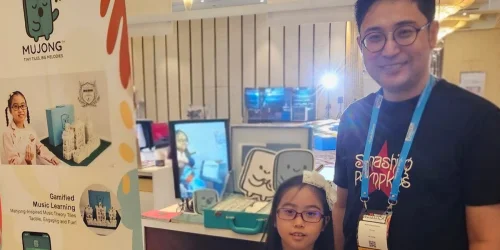
What if your child could turn a "crappy" drawing into a professional mascot in seconds? Or solve a problem by simply asking a computer for help? For one family in Singapore, this isn't a futuristic dream—it’s their new reality.
Boo Kok Chuon, a chief operating officer, and his 8-year-old daughter Kiki have just built a fully functional companion app in a single afternoon. Their secret weapon? A suite of accessible AI tools that are transforming not just industries, but childhoods.
The "Magic" That Turned a Doodle Into a Brand
It started with a simple piece of paper. Kiki sketched a mascot for their music-learning game, Mu Jong. "It was quite a crappy drawing," her father admits. But what happened next stunned them both. By uploading the photo into an AI image generator, Kiki watched her sketch transform. "Wow, it's like magic," she exclaimed, seeing her creation become "commercially ready" almost instantly.
This wasn't passive screen time. Boo guided her to think like a director, instructing her to specify the mascot's purpose and desired traits. Kiki learned to prompt the AI for a "rounder shape, softer colours, friendly expression." The result? A powerful lesson in iterative design and clear communication.
From Spilled Drinks to App Development: A New Kind of Problem-Solving
For Kiki, AI is now her first port of call. She asks ChatGPT how to clean a stained shirt or care for her pet turtles. This foundational comfort led to the ambitious three-hour app project. Using ChatGPT for logic, Base 44 for the interface, and Nano Banana Pro for visuals, they built an app with a score tracker, musical keyboard, and timer.
Kiki conceptualised every feature, while her father helped structure the prompts to translate her ideas into AI instructions. The process taught her to deconstruct problems and use natural language as a powerful tool for creation.
"We Should Not Trust These Systems 100%"
Despite their enthusiasm, the family approaches AI with clear-eyed caution. Boo warns of inherent issues, like AI being "a bit too conservative." More critically, he sees an emotional danger. "If you rely on AI too much, it might be emotionally dangerous," he states, advocating for a cautious, objective approach where human review is non-negotiable.
Their supervision is active and transparent. They review Kiki's YouTube history and internet activity, guiding her with questions like, "Why do you do this?" rather than judgement. It’s a partnership built on oversight and open dialogue.
This Is the Privileged (and Unimpressed) Generation
Kiki represents a new wave of children born into advanced technology. "Nowadays, kids may not be so easily impressed," Boo observes, because the tools are so readily available. The challenge and opportunity lie in teaching them not just to use AI, but to master it creatively and critically.
The three-hour app is more than a project; it's a blueprint. It shows how early exposure, guided by empathetic oversight, can prepare children not just to consume technology, but to command it, shaping their problem-solving skills for a world we are only beginning to imagine.