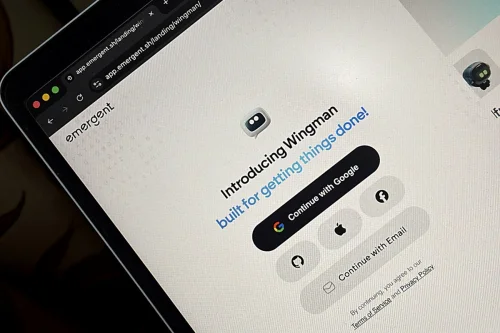
Emergent, a Bengaluru-based startup, has launched "Wingman," a messaging-first autonomous AI agent, marking its expansion from software creation into automated task execution. The company, known for its "vibe-coding" platform that allows non-technical users to build applications, announced the new product on Tuesday. Wingman is designed to operate through popular chat apps like WhatsApp and Telegram, running background tasks across connected tools while seeking user approval for significant actions.
Founded in 2025, Emergent has seen rapid adoption of its core platform, with over eight million builders and 1.5 million monthly active users. The startup, which raised $70 million in January at a $300 million valuation from investors including SoftBank and Lightspeed Venture Partners, is now targeting the growing market for AI agents. This sector has been popularised by tools like OpenClaw and Anthropic's Claude, with major tech firms racing to develop similar systems.
Shifting from Creation to Execution
"The obvious next step for us was, can we help them not just build the software, but actually operate more autonomously through it?" said Mukund Jha, co-founder and CEO of Emergent. He explained the strategic shift to TechCrunch, stating, "You move from software that supports the business to software that can actively help run it." The decision to integrate Wingman into existing messaging platforms was driven by user behaviour, as Jha noted that "a lot of real work already happens through chat, voice, and email."
Building Trust Through 'Boundaries'
Emergent is attempting to differentiate Wingman by embedding it directly into messaging interfaces users already frequent, rather than requiring adoption of a new application. A key feature is the implementation of "trust boundaries," which allow the agent to autonomously handle routine tasks while requiring explicit user approval for more consequential steps. This approach aims to address widespread concerns about the risks of fully autonomous AI systems making unchecked decisions.
Despite its ambitions, the technology faces inherent limitations common to current AI agents. Jha acknowledged that Wingman struggles with "consistency in really ambiguous situations, messy edge cases, unclear goals, or workflows where a lot of human judgment is needed." The system's effectiveness is therefore currently bounded to well-defined, repetitive tasks within clear parameters.
The Competitive AI Agent Landscape
The launch positions Emergent in a increasingly crowded and competitive field. Projects like OpenClaw – previously known as Clawdbot and Moltbot – have gained early traction, while industry giants including Anthropic and Microsoft are developing their own agent-based systems. The core battleground is creating AI that can reliably complete multi-step tasks on behalf of users across different software environments.
Wingman is being introduced with a limited free trial, after which access will transition to a paid model. Existing users of Emergent's vibe-coding platform will be able to access the AI agent through their current accounts. The company's move from a creation-focused tool to an execution-oriented agent reflects a broader industry trend of seeking to make AI a persistent, active assistant in daily digital work.