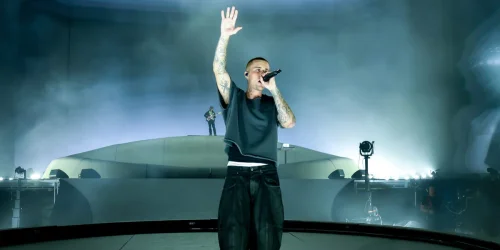
Justin Bieber delivered a subdued and unconventional headline set at the Coachella Valley Music and Arts Festival on Saturday, for which he was reportedly paid $10 million. The performance, his first as a headliner since cancelling his 2022 world tour, was characterised by minimal production and frequent breaks where the singer interacted with a live-stream audience via a laptop on stage.
Wearing casual attire, Bieber performed tracks largely from his 2025 albums and spent roughly 30 minutes of the 90-minute show sitting on stage, scrolling through YouTube. This segment included watching old memes, re-enacting past viral moments, and singing karaoke-style versions of his early hits. The approach stood in stark contrast to the high-energy, visually spectacular sets from fellow headliners Sabrina Carpenter and Karol G.
A Deliberate Departure from Pop Spectacle
The performance has been criticised in some quarters as "lazy and underwhelming", especially given the context of Coachella's reputation for lavish production and Bieber's own history of cancelled tours. However, the extended YouTube segment served as a deliberate callback to his origins. Bieber was famously discovered by manager Scooter Braun after videos of him singing acoustic covers, including Ne-Yo's "So Sick", were posted online.
By duetting with footage of his younger self broadcast to the Coachella crowd, the moment transformed from pure nostalgia into a reflective statement on his career. "It was an homage to how far he's come, and how much he can do with just his voice and a microphone," the performance suggested, according to observers.
Context of a Cautious Comeback
Bieber's appearance followed years of limited public performances, confined mainly to brief award show slots and surprise guest appearances. His 2022 Justice World Tour was cancelled approximately halfway through its scheduled run, mirroring the early termination of his 2016-2017 Purpose World Tour. This history led to significant speculation about the level of commitment he would bring to the coveted Coachella headline slot.
The artist's minimalist choice, foregoing dancers, complex choreography, and elaborate staging, presented a clear alternative to the festival's typical brand-driven spectacle. It emphasised a raw, almost casual connection with his music and his past, prioritising a personal narrative over crowd-pleasing extravagance.
While divisive, the set successfully honoured Bieber's contractual commitment and provided a unique, introspective chapter in Coachella's history, challenging expectations of what a headline performance at the world's most prominent music festival can be.