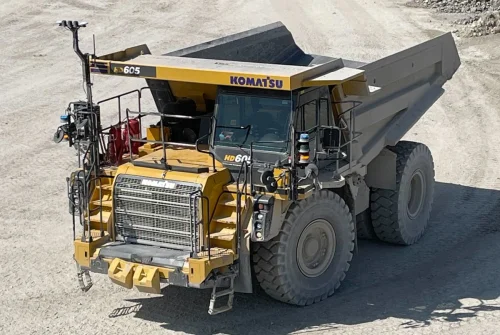
Mariana Minerals, a mining startup founded by former Tesla engineer Turner Caldwell, has announced a partnership with autonomous vehicle company Pronto to deploy self-driving haulage trucks at its Copper One mine in Utah. The deal, the first for Pronto since its acquisition by Travis Kalanick's Atoms venture, will see autonomous operations begin next week as part of Caldwell's vision to revolutionise mining through software and automation.
The integration aims to address a shrinking labour force and inefficiencies in the industry by using a proprietary operating system called "MineOS" to coordinate vehicle dispatch and routes without human intervention. Caldwell, who spent nearly a decade at Tesla, argues that major Western mining companies are resistant to technological change, limiting output and leaving significant efficiencies untapped.
A Software-First Vision for Mining
Turner Caldwell founded Mariana Minerals in 2024 with the explicit goal of increasing the supply of refined metals into the global ecosystem. He draws a direct comparison between traditional mining firms and legacy car manufacturers before Tesla's disruption. "The big Western mining companies look exactly like Ford and GM before Tesla," Caldwell told TechCrunch in an exclusive interview. "The rate at which software is up-taken and technology is up-taken into the space is fundamentally set by the operating teams who don’t really have incentive to change how they operate."
The partnership with Pronto is a key component of this strategy, but it extends beyond simply putting autonomous trucks on site. Pronto's self-driving system will be directly integrated into Mariana's MineOS software, creating a closed-loop system for managing mine logistics. This approach uses reinforcement learning to automate and eventually coordinate operations across the entire mining site.
Addressing an Existential Labour Challenge
Caldwell views the adoption of automation as an existential necessity for the mining sector, not merely a cost-cutting exercise. He cites a diminishing talent pool as Western companies fail to build new infrastructure and attract workers. "Because Western mining companies don’t build a lot of net new infrastructure, the talent pool hasn’t been actively attracted to it, and so the labor force is diminishing," he explained.
He contends that automation will ultimately create more mining jobs by enabling more operations to run efficiently with the constrained workforce. "Part of this is a labour cost reduction, but that’s not really the goal," Caldwell said. "The goal is actually enabling more productivity with the constrained labour pool that we have. Automation, and autonomy, is going to create more jobs, because we will have more mines that are operating."
Vertical Integration Over Software Sales
While the success of MineOS could make it a viable product for other mining companies, Caldwell's primary focus remains on metal production, not software licensing. He argues for vertical integration, drawing a parallel to SpaceX. "The company is the coordination layer. And so, if you’re doing that, like, at that point, you might as well go and vertically integrate, and go down into making the metal, instead of just selling software," he stated. "I think SpaceX would not be a very large company selling [rocket] re-landing software to NASA."
Owning and operating the Copper One mine is crucial for the reinforcement learning process, providing high-fidelity data to train the system. Caldwell likened the potential outcome to DeepMind's AlphaGo, which developed novel strategies unseen by human players after extensive data training.
The financial terms of the deal with Pronto were not disclosed. Pronto, founded by former Google engineer Anthony Levandowski, was recently acquired by Atoms, a robotics venture led by Uber co-founder Travis Kalanick, reuniting the two controversial tech figures. Mariana Minerals purchased the previously idled Copper One mine in Utah last year.