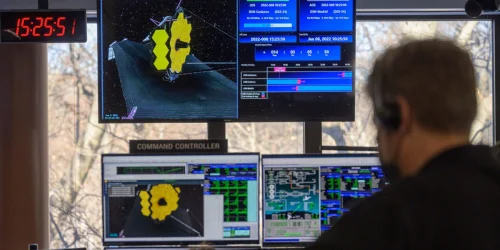
NASA is employing artificial intelligence (AI) and digital twin technology to overcome the extreme challenges of space exploration, from piloting rovers on Mars to monitoring the James Webb Space Telescope. The agency creates virtual, predictive replicas of physical systems and environments, allowing for safer testing and real-time decision-making in conditions where human or hardware failure is not an option.
Kevin Murphy, NASA's acting chief artificial intelligence officer, stated the technology is vital for operating in "some of the most extreme environments imaginable." By layering AI atop digital twins, NASA can now generate predictions, diagnose issues, and recommend actions faster than human analysis alone.
From Apollo to AI: A Pioneering History
The concept of digital twins is not new to NASA, which pioneered it during the 1960s Apollo missions. Today, the integration of AI represents a significant evolution. "AI offers more insights than digital twins alone," Murphy told Business Insider, explaining it can process sensor data at speed to spot anomalies humans might miss.
This combination was crucial for charting a path for the Perseverance rover on Mars. Engineers at NASA's Jet Propulsion Laboratory fed terrain data to an AI model, which generated a safe route. This proposed path was then rigorously reviewed and tested against a digital twin of the rover's environment before commands were sent to the Red Planet.
Testing the Untestable: The James Webb Example
Digital twins proved indispensable for the James Webb Space Telescope, an instrument too large for physical testing in NASA's thermal vacuum chambers. The agency created two specialised twins: a 3D video model to track the complex unfurling of its sunshield, and a thermal model of the telescope's core to prevent overheating that could blind its instruments.
Julie Van Campen, a Webb mission systems engineer, noted these models were built in the early 2000s, before modern AI. Today, AI is used to analyse the telescope's vast daily data output. "Van Campen likened the data sets to a gold mine — and AI helps unearth the nuggets and treasures buried inside," the report stated.
High-Stakes Industry Adoption
The broader aerospace industry, including companies like Airbus and Boeing, is adopting these technologies for predictive maintenance and simulation. Karen Willcox, director of the Oden Institute at the University of Texas at Austin, highlighted that a quarter of a fighter jet's budget can be spent on test and evaluation, a process digital twins can accelerate.
However, the life-and-death stakes in aerospace demand extreme caution. "You could go much faster if you didn't have to worry about being wrong," Willcox said. "That's not the way we do things in aerospace." She emphasised that human oversight, verification, and validation of AI outputs remain non-negotiable.
A Future of Complementary Technology
Murphy and Willcox envision a future where AI and digital twins complement human expertise, enabling a natural-language dialogue between professionals and the virtual model for real-time decision support. For NASA, this means extensive pre-deployment testing—checking over 500,000 variables for Perseverance's AI—and continuous verification against real-world performance.
The core mission, Murphy concluded, is to "explore options, make decisions, and spot problems — without putting people or hardware at risk."