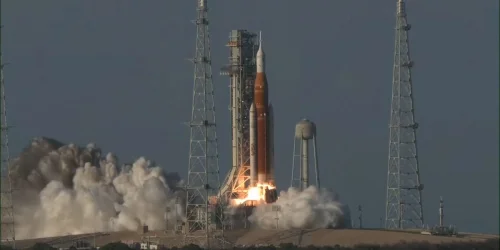
NASA has successfully launched the Artemis II mission, marking the United States' first crewed lunar mission in more than five decades. The Space Launch System (SLS) rocket lifted off from Launch Complex 39B at the Kennedy Space Center in Florida at the scheduled time. The mission's primary objective is to test the Orion spacecraft's systems with a crew aboard in deep space, paving the way for future Artemis missions aimed at establishing a sustainable human presence on the Moon.
The four-person crew—NASA astronauts Reid Wiseman, Victor Glover, and Christina Koch, along with Canadian Space Agency astronaut Jeremy Hansen—are now en route to the Moon. Over the next ten days, the uncrewed Orion capsule will perform a lunar flyby, venturing thousands of miles beyond the far side of the Moon before returning to Earth for a splashdown in the Pacific Ocean. This mission is a critical full systems test before Artemis III, which plans to land astronauts on the lunar surface.
A Decade in the Making
The launch represents the culmination of years of development and testing for NASA's SLS rocket and Orion spacecraft, programs that have faced significant delays and budget overruns. "Today, we are witnessing history," stated NASA Administrator Bill Nelson in a post-launch address. "Artemis II is the next bold step in returning humans to the Moon and going further than ever before." The mission is a cornerstone of NASA's Artemis programme, which aims to land "the first woman and the first person of colour" on the Moon.
The successful launch follows the uncrewed Artemis I test flight in late 2022, which demonstrated the SLS rocket and Orion capsule could complete the journey to the Moon and back. Data from that mission informed final preparations and crew safety protocols for Artemis II. "Every system on board has been rigorously tested," said Mission Commander Reid Wiseman in a pre-recorded message. "We are confident in our spacecraft and ready to execute this mission."
Technical Milestones and Global Partnerships
The mission will see Orion travel approximately 6,400 miles beyond the far side of the Moon, the farthest any spacecraft designed for humans has ever flown from Earth. Key objectives include testing the spacecraft's life support, communication, and navigation systems in the deep space environment. A critical manoeuvre will involve the European Service Module, provided by the European Space Agency (ESA), which will propel Orion into and out of lunar orbit.
International collaboration is a hallmark of the Artemis programme. Alongside ESA's contribution and a Canadian crew member, the mission involves partnerships with other space agencies and commercial entities. The success of Artemis II is seen as vital for maintaining the programme's momentum and securing continued political and financial support for its long-term goals, which include the planned Lunar Gateway station and sustained lunar exploration.
The Road Ahead for Lunar Exploration
Assuming Artemis II completes its objectives, NASA will proceed with Artemis III, currently scheduled for no earlier than September 2026. That mission intends to achieve a crewed landing near the lunar south pole, a region believed to contain water ice. The data and experience gained from Artemis II's crewed flight are essential for validating the technologies and operations needed for that historic landing.
NASA officials have emphasised that the Artemis missions are a proving ground for the technologies and human experience required for an eventual crewed mission to Mars. "This is more than a return to the Moon," said Victor Glover, the mission's pilot. "We are laying the groundwork for humanity's future in the solar system." The crew is expected to conduct live video broadcasts and scientific observations during their journey, providing unprecedented views and data from cislunar space.