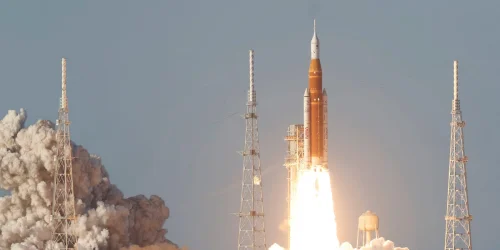
NASA successfully launched the Artemis II mission on Wednesday evening from Kennedy Space Center in Florida, sending a crew of four astronauts on a lunar flyby for the first time in over 50 years. The Orion spacecraft, nicknamed "Integrity" by its crew, lifted off at 6:35 p.m. local time, marking the start of a critical 10-day test flight around the Moon.
The mission represents a major milestone in international space cooperation, involving NASA, the Canadian Space Agency (CSA), and the European Space Agency (ESA). It is the first crewed mission of the Artemis program, which aims to return humans to the lunar surface and establish a foundation for future missions to Mars.
Historic Crew and Mission Objectives
The Artemis II crew consists of Commander Reid Wiseman, Pilot Victor Glover, and Mission Specialists Christina Koch and Jeremy Hansen. This mission includes several historic firsts: Koch is the first woman assigned to a lunar mission, Glover is the first person of colour, and Hansen is the first Canadian.
Commander Wiseman is a veteran of a 165-day mission aboard the International Space Station. The primary objective of Artemis II is to rigorously test the Orion spacecraft's living and working conditions in deep space, ensuring its systems are ready for longer-duration missions.
Flight Path and Technical Preparations
Following launch, the spacecraft will enter multiple orbits around Earth during its first 24 hours. NASA expects Orion to reach the far side of the Moon around flight day six before returning to Earth for a splashdown in the Pacific Ocean around April 10 or 11.
The Orion spacecraft, built by Lockheed Martin, is designed to withstand the extreme environment of deep space. It was previously tested on the uncrewed Artemis I mission in 2022, which saw the capsule travel 1.4 million miles beyond the Moon and back, re-entering Earth's atmosphere at a speed of 24,581 mph.
A Stepping Stone to Mars
While Artemis II does not involve a lunar landing, NASA Administrator Jared Isaacman emphasised its critical role as a proving ground. "You're doing it for the scientific potential, economic potential, as a technological proving ground to do the things on the moon that you're going to need on Mars," Isaacman stated in an interview with CBS News.
The mission paves the way for Artemis III, which is currently targeted for 2027 and aims to land astronauts on the lunar surface using commercial lunar landers. The Artemis program's ultimate goal is to use the Moon as a base for the first human missions to Mars.