Throughout American history, presidents have repeatedly ordered significant military operations without seeking a formal declaration of war or specific authorisation from Congress. This practice, which has become more common since World War II, raises persistent constitutional questions about the balance of war powers between the executive and legislative branches.
Legal scholars and historians argue this represents a steady concession of congressional authority to the presidency. "Since 1946, Congress has relinquished this constitutional authority and granted it to the president, probably much to the founders' chagrin," said Andrew Wiest, a professor of military history at the University of Southern Mississippi. "The founders were extremely wary of a president with too much military authority."
Early Precedents and the "Police Action"
Following the Spanish-American War, the Philippine-American War (1899-1902) began without President William McKinley seeking a formal declaration. He interpreted the recent congressional ratification of the Treaty of Paris, which ceded the islands to the US, as implicit approval for military action to suppress Filipino revolutionaries. The conflict resulted in approximately 4,200 American and 20,000 Filipino combatant deaths, with up to 200,000 civilian fatalities from related violence and disease.
The Korean War (1950-1953) saw President Harry Truman commit forces under a United Nations mandate, labelling it a "police action" and bypassing Congress. This framing was contested, with Senator Robert Taft calling it "a complete usurpation by the president." The war cost 37,000 American lives and an estimated 5 million total casualties.
The War Powers Resolution and Its Limits
President Richard Nixon's secret bombing of Cambodia (1969-1973), conducted during the Vietnam War after Congress had repealed the Gulf of Tonkin Resolution, prompted a legislative response. Congress passed the War Powers Resolution of 1973 to curtail presidential power, overriding Nixon's veto. The US dropped 540,000 tons of bombs on Cambodia, with civilian death estimates ranging from 150,000 to 500,000.
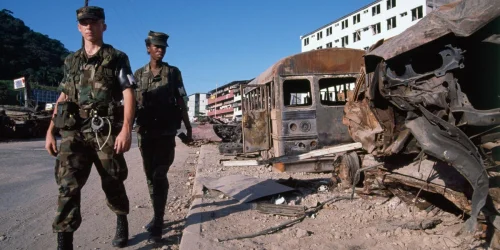
Despite this law, presidents have continued to act. The invasion of Grenada (1983) under President Ronald Reagan and the invasion of Panama (1989) under President George H.W. Bush were conducted without prior congressional approval, though both enjoyed strong public and legislative support after the fact.
The Modern Era: Airstrikes and International Mandates
In recent decades, military action has often been framed by international coalitions or limited to air power. The NATO bombing of Yugoslavia (1999) during the Kosovo War proceeded under President Bill Clinton despite a failed House vote to authorise the strikes. Similarly, the 2011 NATO intervention in Libya under President Barack Obama used a UN Security Council resolution as justification, bypassing Congress and leading to a failed legal challenge by lawmakers.
Professor Wiest notes a double standard: "The use of air power has almost been a kind of national 'Get Out of Jail Free' card when it comes to opening these types of conflicts." This is evident in ongoing strikes against Houthi targets in Yemen, conducted by both the Biden and Trump administrations without seeking new congressional authorisation.
Recent Operations in the Trump Administration
The trend has continued. In an operation codenamed Operation Midnight Hammer, the Trump administration struck Iran's nuclear facilities, arguing it was necessary to prevent nuclear weapon development. While supported by most Republican lawmakers, it drew criticism for the lack of congressional authorisation.
Most recently, on 3 January 2026, the Trump administration conducted strikes on Venezuela that deposed President Nicolás Maduro, framing them as "law-enforcement operations" against a "narco-terrorist organization." The action resulted in approximately 75 deaths and injured seven American troops. A subsequent Senate war powers resolution was blocked by the Republican majority.
This historical pattern underscores an enduring tension in US governance. While Congress holds the constitutional power to declare war, political dynamics, international alliances, and the nature of modern warfare have increasingly concentrated the decision to use military force in the hands of the president.