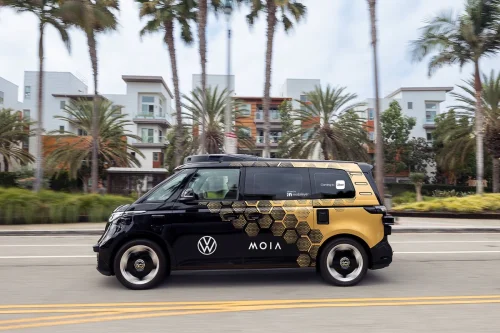
MOIA America, a subsidiary of Volkswagen Group, and Uber have commenced testing of autonomous electric minibuses in Los Angeles, the companies announced on Wednesday. The testing phase represents a critical step towards launching a commercial robotaxi service by late 2026, using a fleet of specially adapted Volkswagen ID. Buzz vehicles.
The partnership, first announced a year ago, aims to deploy the autonomous ride-hailing service across multiple U.S. cities over the next decade. Los Angeles has been selected as the inaugural test market, with operations based out of a newly established joint facility in the city.
Initial Phase and Scaling Plans
Testing will begin in the coming weeks with approximately 10 autonomous Volkswagen ID. Buzz vehicles. The production version of these driverless minivans is configured to seat four passengers. While the initial fleet is small, Volkswagen has stated plans to eventually scale operations in Los Angeles to more than 100 autonomous vehicles.
Paul DeLong, President of Commercialization at MOIA America, described Los Angeles as a "natural market" for introducing the technology, citing its history of shaping car culture and adopting new mobility solutions. The vehicles will launch with a human safety operator on board, with the transition to fully driverless operations anticipated for 2027.
Strategic Rebranding and Regulatory Pathway
The MOIA America name is a recent rebranding of Volkswagen's autonomous mobility efforts in the United States, previously known as Volkswagen ADMT. The MOIA brand itself was launched by Volkswagen in 2018 and is established in Europe, where it operates ride-pooling services and tests autonomous technology in cities including Hamburg and Oslo.
Before a commercial, fare-charging robotaxi service can launch, the company must navigate California's regulatory framework. This requires securing permits from the California Department of Motor Vehicles for autonomous vehicle testing and deployment, as well as a ride-hailing permit from the California Public Utilities Commission.
Uber's Broader Autonomous Strategy
For Uber, the Volkswagen partnership is one part of a diversified strategy in autonomous technology. The ride-hailing giant has partnerships with 25 companies applying autonomous systems to delivery, drones, ride-hailing, and trucking. Its most prominent U.S. partnership is with Waymo.
Uber has also expanded its autonomous vehicle ambitions internationally, securing agreements with Chinese firms to launch robotaxis in Europe and the Middle East, and investing in startups like UK-based Wayve. In a separate major deal, Uber recently agreed to purchase 10,000 fully autonomous R2 robotaxis from Rivian, accompanied by a $300 million investment, ahead of a planned rollout in San Francisco and Miami in 2028.