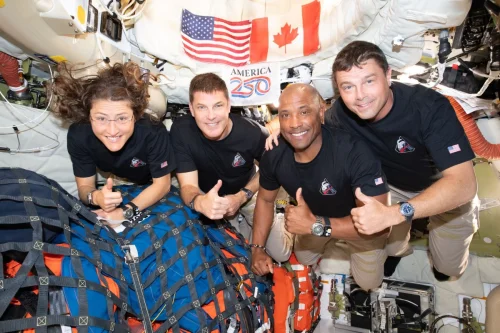
The four astronauts of NASA's Artemis II mission have returned safely to Earth, concluding a historic 10-day journey that took them around the Moon. The Orion spacecraft, named *Integrity*, splashed down in the Pacific Ocean off the coast of San Diego, California, at 5:07 p.m. Pacific Time on Tuesday.
Commander Reid Wiseman, pilot Victor Glover, and mission specialists Christina Koch and Jeremy Hansen were all reported to be in "green," or healthy, condition following what NASA officials described as a "perfect" landing. The mission marks the first time humans have travelled to lunar orbit since the Apollo program ended in 1972.
A Journey of Records and Discovery
During their mission, the crew travelled an estimated 252,760 miles from Earth, setting a new record for the farthest distance humans have ever travelled from our planet. Their flight path took them on a flyby of the Moon, allowing them to photograph previously unseen parts of the lunar surface and witness a total solar eclipse from a unique vantage point.
The astronauts also participated in geological observations, identifying new craters. In a personal tribute, the crew named one newly identified crater after Commander Wiseman's late wife, Carroll, who died of cancer in 2020.
Test Flight Paves Way for Lunar Return
Artemis II served as the first crewed test flight of NASA's powerful Space Launch System (SLS) rocket and the Orion spacecraft. NASA Administrator Jared Isaacman, a commercial astronaut, emphasised the mission's critical role. "This was a test mission... pushing farther into the unforgiving environment of space than ever before, and it carried real risk," he stated in a post on X.
Isaacman celebrated the crew as "ambassadors to the stars" and signalled the mission's broader purpose: "They accepted that risk for all we stood to learn and for the exciting missions that follow, as we return to the lunar surface, build a Moon base, and prepare for what comes next."
The Road Ahead for Artemis
The success of Artemis II is a major milestone for NASA's Artemis program, which aims to establish a sustainable human presence on the Moon. The data gathered on this mission will be crucial for preparing Artemis III, currently planned to land astronauts near the lunar south pole.
With the crew's safe return, focus now shifts to analysing the spacecraft's performance and preparing the next Orion capsule and SLS rocket for future missions, reaffirming the United States' commitment to deep space exploration.