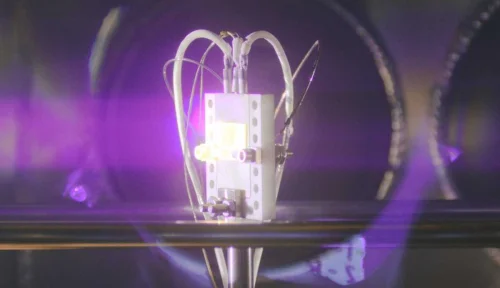
Avalanche Energy, a Seattle-based fusion startup, has been awarded a $5.2 million contract from the U.S. Defense Advanced Research Projects Agency (DARPA) to develop advanced radiovoltaic materials. The exclusive announcement, made to TechCrunch, highlights a significant step in harnessing radiation for electricity generation.
The contract is part of DARPA's interest in a new class of nuclear batteries, which use radioactive decay from isotopes like polonium to produce power. Such devices could provide long-term energy for spacecraft, satellites, and autonomous military systems where logistical support is challenging.
Bridging Fusion and Battery Technology
While the DARPA award focuses on nuclear batteries, its goals overlap directly with Avalanche Energy's core mission: developing a compact, desktop-scale fusion reactor. Both fusion reactions and nuclear batteries produce alpha particles, a highly energetic form of radiation that is difficult to harness and can damage equipment.
Daniel Velásquez, materials science lead at Avalanche Energy, explained the challenge: "A fusion reactor that makes power... already exists. A fusion reactor that makes electricity is better." Current methods to capture fusion energy, like heating water to spin turbines, are inefficient, converting at best around 60% of the power.
The Radiovoltaic Breakthrough
Radiovoltaics function similarly to solar panels but convert radiation, not light, into electricity via semiconductors. Existing versions are inefficient and prone to radiation damage. Avalanche's research aims to create new, more robust materials that can withstand and efficiently capture alpha particles.
Success would serve a dual purpose. For DARPA, it enables powerful, long-lasting nuclear batteries. For Avalanche, it could lead to a protective sheathing for its fusion reactor that simultaneously generates additional electricity from the alpha particles, boosting overall efficiency.
Accelerating the Fusion Race
The global fusion industry is racing to achieve breakeven (Q>1), where a reactor produces more power than it consumes. Effectively capturing alpha particle energy could make commercial fusion power more attainable. Avalanche also recently secured a $1.25 million award from the U.S. Air Force's AFWERX lab to use computational tools to speed up materials discovery.
If successful, Avalanche could find itself supplying radiovoltaic technology to other fusion companies, a growing trend of specialised suppliers within the sector. The company's reactor design is one of several that produce alpha particles, making the potential application of its research broad.
The development underscores a strategic shift in advanced energy research, where military funding for dual-use technologies—applicable in both defence and civilian sectors—could provide critical breakthroughs for the long-sought goal of clean, abundant fusion power.