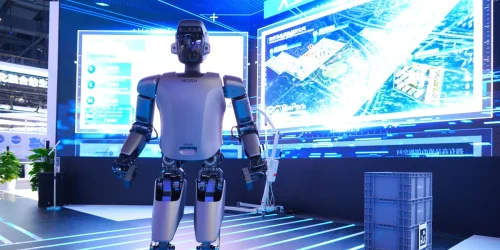
A leading Chinese humanoid robotics company is offering a salary of up to $18 million (£14.2 million) to recruit a new Chief Scientist, marking a significant escalation in the global competition for top artificial intelligence talent. Shenzhen-based UBTech Robotics posted the job listing this month for a "Chief Scientist of Embodied Intelligence," with a pay range spanning from 15 million to 124 million yuan ($2.2 million to $18 million).
The successful candidate will be tasked with accelerating the company's push into manufacturing, services, and "family companionship" applications for its humanoid robots. This move signals that China's fast-growing tech sector is becoming more aggressive in attracting world-leading expertise, a trend previously more associated with Silicon Valley's talent wars.
Escalating Global Talent Competition
The top-end salary, while substantial, remains below the most eye-watering packages reported in the core AI sector, where companies like Meta and OpenAI have been accused of attempting to poach star researchers with compensation deals worth up to $100 million. However, UBTech's offer represents a notable departure for China's robotics industry, which has largely avoided such vast public payouts until now.
Founded in 2012, UBTech has grown into one of China's most prominent humanoid robotics firms. Its flagship product is the 5-foot-9 Walker S2, a robot designed for autonomous operation in factory settings, similar to Tesla's Optimus robot. Earlier this year, UBTech announced a deal with aerospace giant Airbus to test its Walker S2 models on factory production lines.
China's Leading Position in Humanoid Robotics
Chinese companies currently hold a dominant position in the global humanoid robotics market. According to data from research firm Omdia, nearly 90% of global humanoid robot shipments in 2023 came from Chinese manufacturers.
The technology has also been a centrepiece of national showcases. During China's recent Spring Festival, a major public event for displaying cutting-edge technology, humanoid robots from another Chinese firm, Unitree, performed kung-fu and acrobatics for audiences.
This domestic advancement has drawn international attention. In a January earnings call, Tesla CEO Elon Musk stated that the biggest competition for Tesla's Optimus robot would come from China. He added, however, that he expects the Optimus—which is scheduled to begin mass production this year—to outperform any robot under development in China.
Defining the Role and Its Impact
The "Chief Scientist of Embodied Intelligence" role at UBTech is explicitly focused on advancing the integration of AI with physical robotic forms. Embodied AI is a frontier field where intelligence is developed within and for interaction with a physical body and environment, a critical step for creating truly useful humanoid robots.
The job listing underscores the strategic importance UBTech places on this area as it seeks to expand from industrial applications into broader service and consumer markets. The company's willingness to offer a compensation package of this magnitude indicates the high value it places on securing a visionary leader to guide this technically complex endeavour.
Industry analysts suggest this recruitment drive reflects a broader strategic shift, as Chinese tech firms move to secure the specialised talent required to maintain their competitive edge in next-generation technologies against well-funded Western rivals. The outcome of this search will be closely watched as a barometer for the intensity of the ongoing global race in advanced robotics.