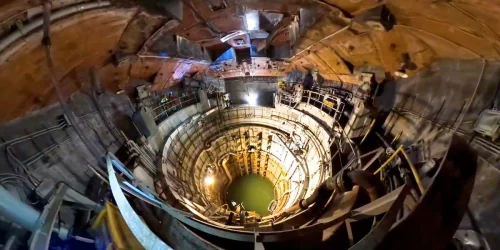
Nik Halik, an Australian venture capitalist, has purchased a decommissioned Titan I nuclear missile silo in Colorado and is overseeing its multi-million dollar conversion into a modern AI data centre. The facility, built during the Cold War and capable of launching 4.5-megaton nuclear warheads, was acquired from the US government in 2021 for over $10 million.
Halik, a self-described "thrillionaire" known for extreme adventures, has spent the last five years renovating the sprawling underground complex located at a top-secret site. His vision repurposes the silo's inherent security and environmental controls to meet the demanding infrastructure needs of advanced artificial intelligence systems.
A Cold War Relic Reimagined
The silo is one of 18 built across the United States to house Titan I intercontinental ballistic missiles (ICBMs) during the height of the Cold War. According to the National Park Service, 54 of these 98-foot-tall missiles, with a range of over 6,000 miles, were operational between April 1962 and January 1965 before being made obsolete by newer technology.
The facility descends 165 feet below the surface and was engineered with multiple layers of steel-reinforced concrete, with each square inch able to withstand roughly 15,000 pounds of pressure. "The fate of the Western world was in the hands of these 21- to 22-year-olds who had the keys to the missiles," Halik told Business Insider during a tour.
Renovation Challenges and Hidden Dangers
The transformation has been documented on Halik's YouTube channel, Nuclear Bunker Living, and involves significant challenges. The basement level is contaminated with cyanide, lead paint, mercury, and asbestos, requiring extensive remediation.
Halik has admitted to safety risks during exploration, including crawling through a pipe with a live wire that could have electrocuted him. "There are so many variables of danger here," he said in a video. "This place is unforgiving."
The Strategic Advantage for AI
Halik's project aligns with a growing trend of using underground facilities for data processing. The silo's naturally cool temperature of 52 degrees Fahrenheit (11°C) year-round is a critical advantage, as cooling can consume over 30% of a data centre's electricity, according to the Pew Research Center.
"AI needs power," Halik stated. "AI needs safe environments to basically have all their computational processing power." To meet this demand, he plans to replace the silo's original diesel infrastructure—which includes tanks holding 50,000 gallons of fuel each—with small nuclear reactors for a self-sufficient power supply.
From Launch Codes to Nightclubs
During renovations, Halik's team discovered original papers containing launch codes, times, and protocols in the control room. While preserving such relics, Halik also envisions recreational spaces within the complex, including a nightclub with a DJ and Cirque du Soleil dancers—a concept being realised at a similar decommissioned site in New Mexico hosting the ATOMIKA festival.
The project mirrors other underground data ventures, such as Iron Mountain's use of a 220-foot-deep, 40-acre former limestone mine in Pennsylvania, highlighting the industry's shift towards secure, environmentally stable locations.