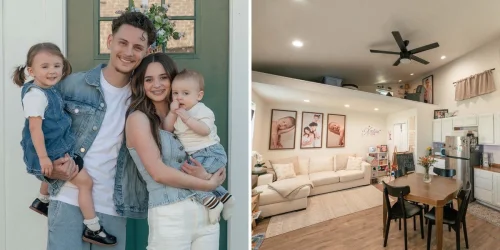
Brielle Matranga, 25, and her husband have spent four years living in a 560-square-foot tiny home they built themselves on a family-owned lot in New Orleans. The full-time content creators, who began construction during the 2020 pandemic, now navigate family life in the compact space with their 3-year-old daughter, Xalia, and 6-month-old son, Lyric.
The couple completed the original 416-square-foot structure in May 2022, living in a studio-like setup before expanding to add a bedroom for their growing family. While the home fosters a sense of closeness and is easier to clean, Matranga told Business Insider the experience has revealed significant design and lifestyle trade-offs.
Architectural Wins: Height, Light, and a Defined Entry
Twelve-foot ceilings are a standout feature, making the space feel larger and allowing for high windows that dramatically increase natural light. "Anybody who is making a tiny home, I would recommend that," Matranga said. "As tall as you can make the ceilings, make them. It makes it feel so big."
The later addition of a small foyer, decorated with shelving and family photos, successfully breaks up the open floor plan. "When you used to walk in, it was like you just walked into the entire thing," Matranga explained. "Now it has that little space that makes it a little bit more homey."
Functional Compromises in Kitchen and Laundry
The kitchen, built with secondhand cabinets and budget countertops, includes a two-burner stovetop and a window above the sink. However, a critical oversight was the lack of a designated trash can location, forcing it to block the pocket door to the bathroom. "It was something we really didn't think about," Matranga admitted.
Further regrets include a small sink and the decision to forgo a dishwasher, a choice that became burdensome after having children. "The dishes are the hardest part," she said. "Because our sink is small, it gets filled up quicker, and with four people, it's just constant dishes."
The family also lacks in-unit laundry, relying on the washer and dryer at her in-laws' adjacent home—a plan that has become impractical. "Now, we're hauling four loads of laundry all the way across, and it's a lot," Matranga said. Space originally earmarked for an outdoor laundry room was used for the bedroom addition instead.
Living with Lofts and the Challenge of 'Visual Overwhelm'
The home features two lofts: one above the living room, accessible by a telescoping ladder, and another above the bedroom with a permanent staircase. The living room loft creates a "cute little nook" but also exposes stored items. The bedroom loft functions as an office, with Matranga cleverly converting the space under its stairs into a mini-closet for her son.
Matranga identified the open-concept main living area as a primary pain point, describing the visibility of toys, kitchen, and living space as visually "overwhelming." She frequently declutters and wishes for better separation or more built-in storage.
Maximised Storage in Bedroom and Bathroom
The family of four shares a single bedroom with a queen-sized bed and a bassinet. Ikea closet systems with deep drawers and a bed with internal lift-up storage are key to managing belongings. "I did not want a cluttered bedroom," Matranga stated.
The full-sized bathroom, complete with a bathtub, maximises vertical space with wall shelving and a custom vanity with hidden compartments. "Anything that can be a shelf and go on the wall is ideal," Matranga advised for tiny living.
Lessons Learned for the Next Build
Despite the challenges, Matranga values the coziness and connection the tiny home fosters. "Even though our tiny home might be small, it holds everything that matters to us," she said. The couple is now building a slightly larger home, intending to retain a sense of openness while incorporating design lessons—like adding an archway for visual separation between rooms.